La Geria Lanzarote: The Volcanic Wine Region Explained
La Geria is a 5,255-hectare protected landscape in southern Lanzarote where vines grow in hand-dug pits cut into volcanic ash, strung along the LZ-30 road between Teguise and Uga. It is also, confusingly, the name of a hotel in Puerto del Carmen that has nothing to do with the wine region.
Short answer
La Geria is Lanzarote's wine country: a protected volcanic landscape of 5,255 hectares across five municipalities, where vines grow in pits dug through ash from the 1730-1736 eruptions. The LZ-30 road runs its length from the Monumento al Campesino junction to Uga, and every major resort sits within half an hour of it.
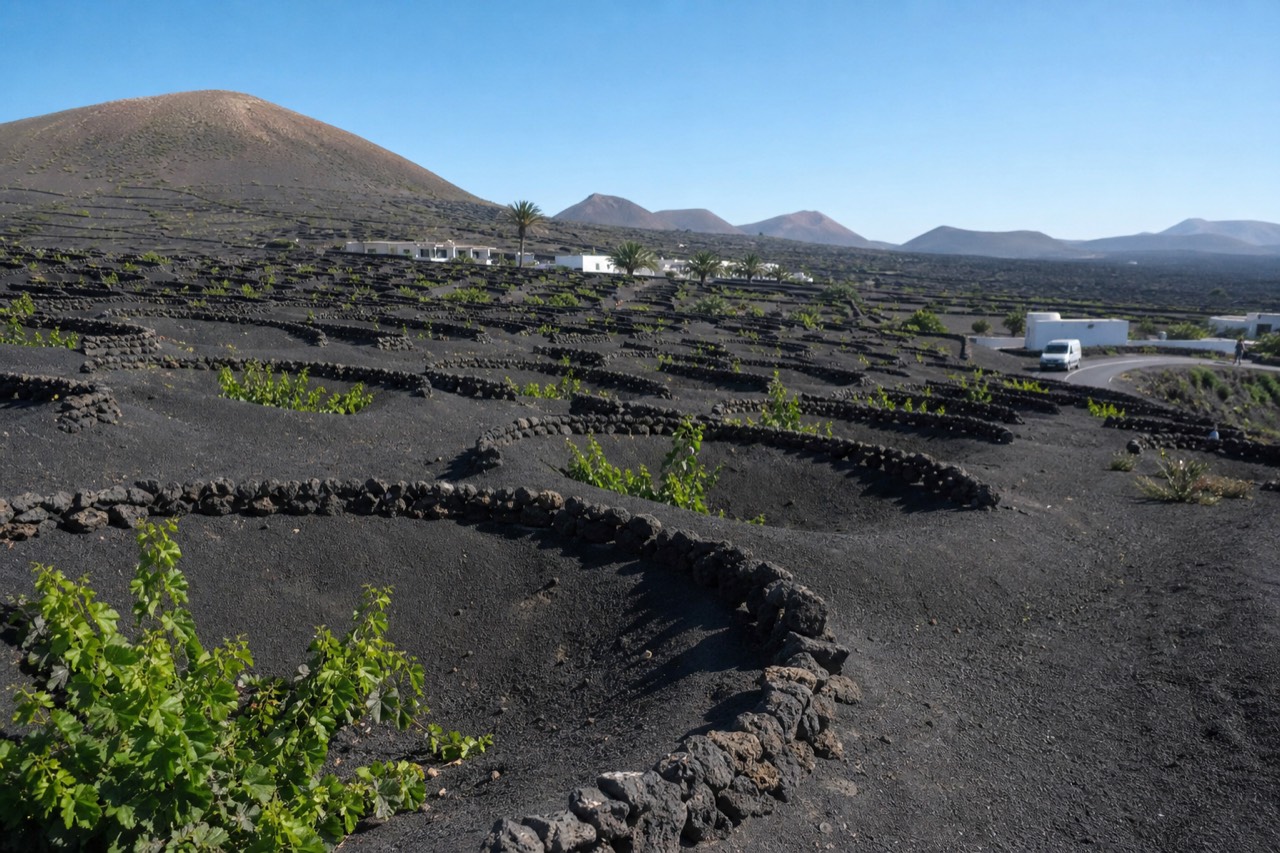
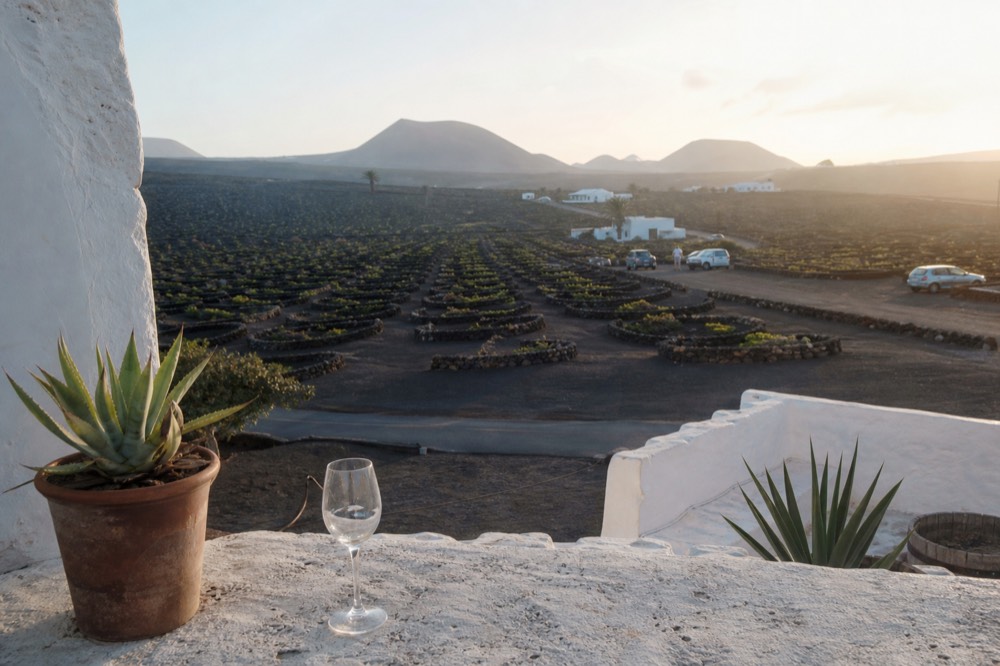
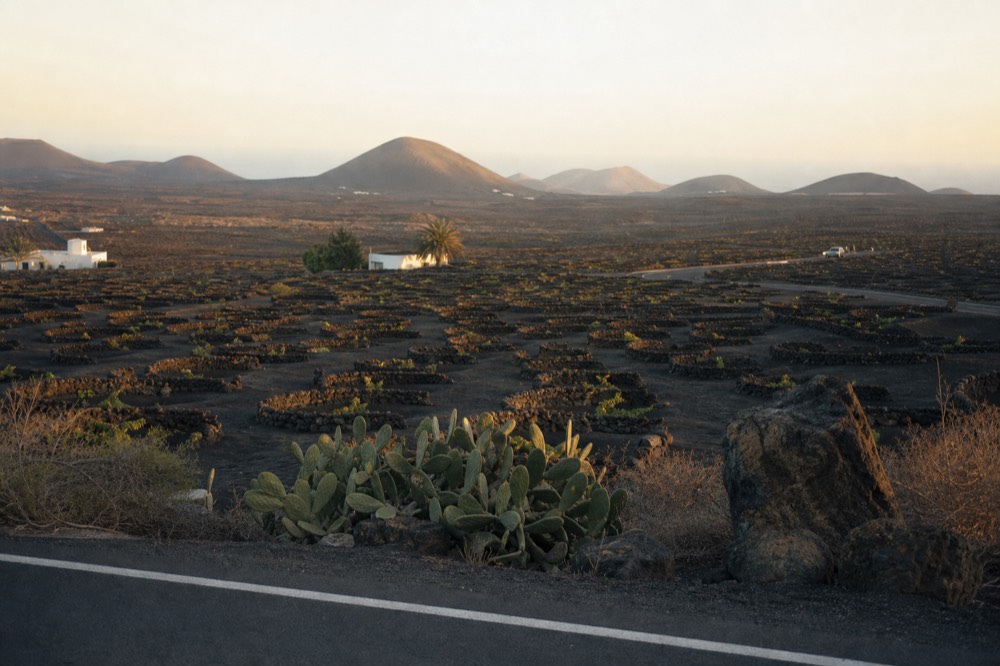
La Geria is the strangest-looking vineyard in Europe, and most first-time visitors drive straight past the reason why. The vines sit in pits, one or two to a hollow, each hollow ringed on its north side by a half-moon of dry stone. There is no trellis row anywhere, no sea of green, just black ash punctuated by green circles that go on for kilometres. The landscape exists because six years of eruptions between 1730 and 1736 buried the island's farmland under lapilli, and where the lava did not run, farmers dug down through the ash and replanted.
This guide covers what the region actually is, where it starts and ends, which bodegas sit on the strip, and one piece of disambiguation worth knowing: Hipotels La Geria shares the name and sits in Puerto del Carmen, a hotel in Puerto del Carmen that is nowhere near the wine region.
Where Is The La Geria Wine Region Located?
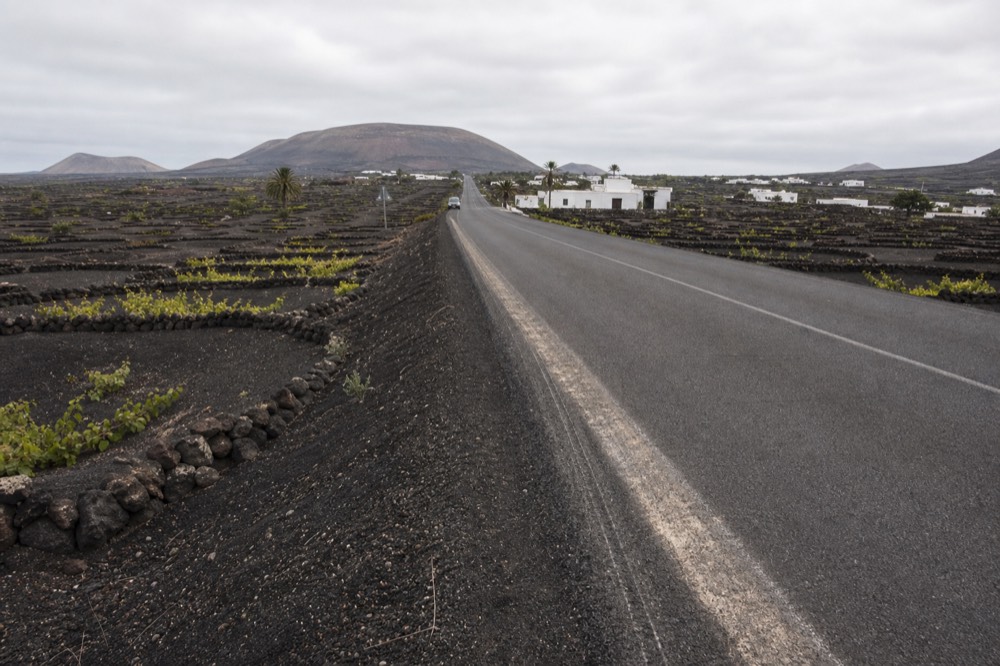
La Geria sits in south-central Lanzarote, stretched along the LZ-30 road between the Monumento al Campesino junction near San Bartolomé and the village of Uga at the foot of the Timanfaya massif. It is a protected landscape of 5,255 hectares spanning five municipalities: Tinajo, Yaiza, Tías, San Bartolomé and Teguise. Its western edge borders the Parque Natural de Los Volcanes, which in turn wraps around Timanfaya National Park.
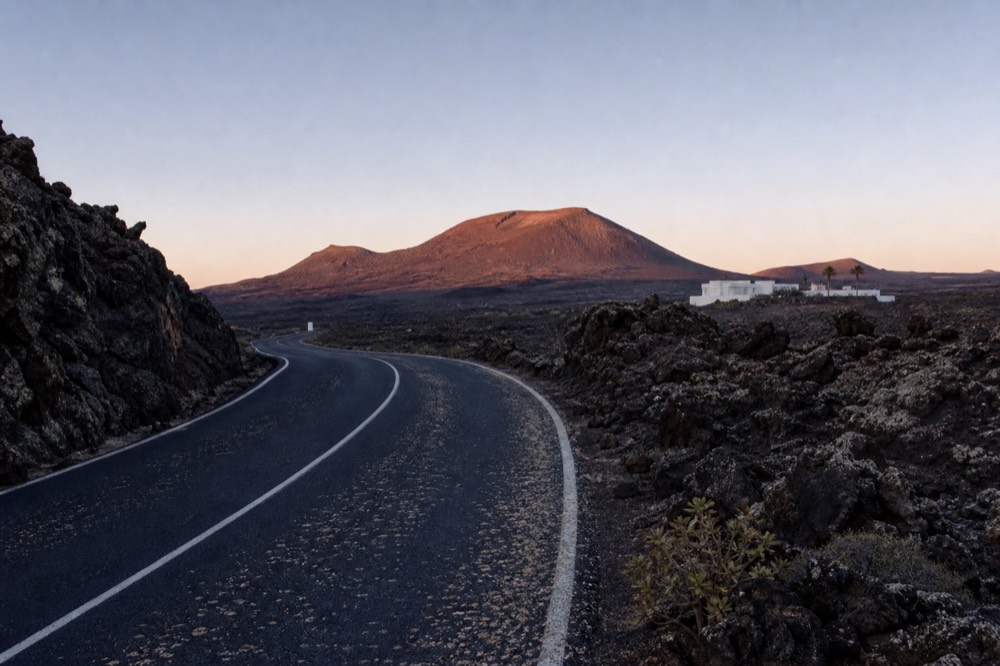
The region is not a town or a single estate. It is a valley, roughly funnel-shaped in the island's mental geography, where the ash from the Timanfaya eruptions fell thickest. The LZ-30 runs through it lengthwise from northeast to southwest, and that road is the practical spine of any visit: nearly every bodega open to the public has its gate on or just off it. Side roads thread off it, including the LZ-56 from Mancha Blanca and the LZ-58 towards Masdache and La Vegueta.
Distances are short. This is a small island, and a wine outing here is a half-day, not an expedition. Approximate driving times to the heart of the valley, based on routing estimates rather than any official published table:
| From | By road | Typical drive |
|---|---|---|
| Puerto del Carmen | 14.0 km | ~17 min |
| Lanzarote Airport (ACE) | 15.8 km | ~22 min |
| Arrecife (town centre) | 20.2 km | ~21 min |
| Playa Blanca | 23.7 km | ~25 min |
| Costa Teguise | 28.2 km | ~29 min |
If you want the full drive mapped out, with the road surface, event closures and where to stop, our La Geria wine route driving guide goes deeper on the LZ-30 itself.
Does Lanzarote Have Vineyards?
Yes, and more than most visitors expect: roughly 1,900 hectares are registered under the island's Denominación de Origen, worked by about 1,860 growers across 41 registered bodegas, per the Spanish agriculture ministry's 2023/24 DOP report. The DO covers the whole island, all seven municipalities, but La Geria is its heart and its image. Around 84 per cent of what the DO sells is white wine, and about 98 per cent of it never leaves Spain.
Those last two numbers explain something you will notice on the shelf at home: Lanzarote wine is genuinely scarce. The island received 3,455,200 tourists in 2025, a record, while the harvest that same year brought in just 843,000 kilos of grapes. The 2025 vintage was officially qualified "muy buena" after a blind tasting of 23 wines, and it produced 1,502,656 bottles, one of the smallest crops in years. Most of that is drunk by the people standing in the bodegas.
The vineyards themselves look like nothing else because of how they are planted. In the deepest-ash zone of La Geria there are about 36 vine pits per hectare. A conventional European vineyard runs to several thousand vines in the same space.
Seeing the landscape and tasting its wine are two different plans, and the best-value options do both. These three cover the range: a seated tasting in the region itself, a hike through it, and a driven multi-winery day.
Which Bodegas Sit On The Strip, And In What Order?
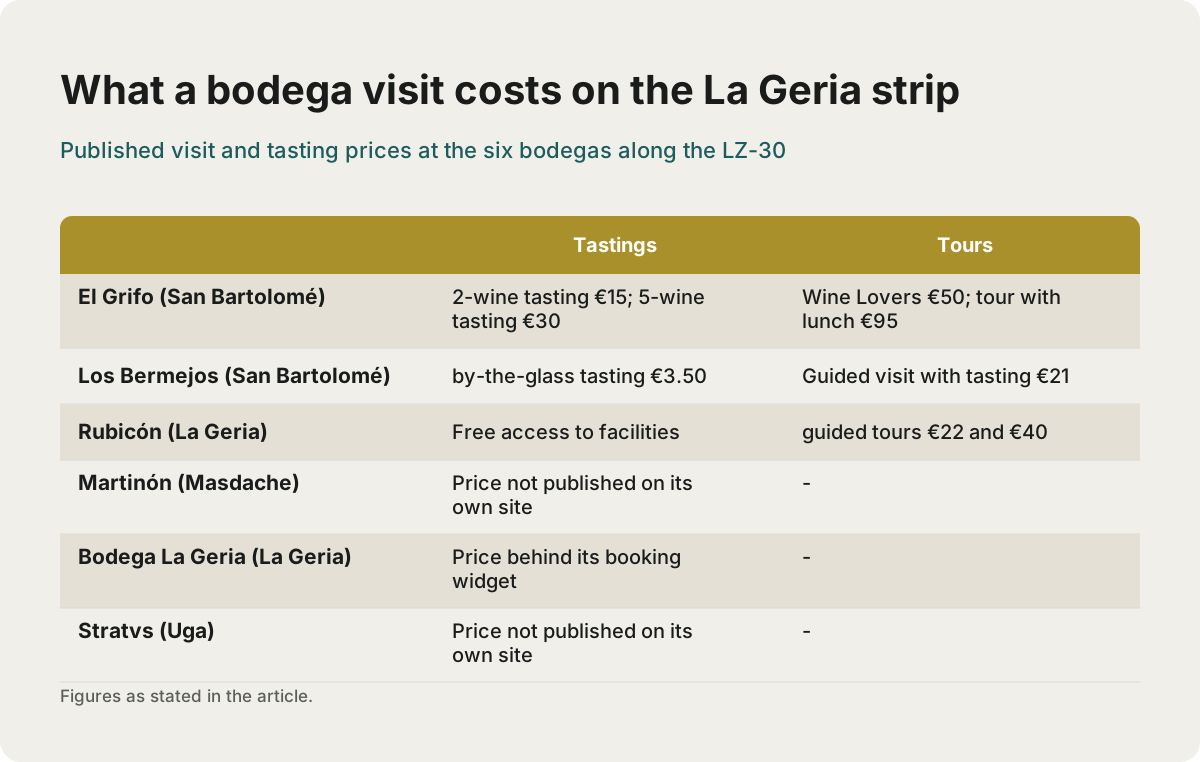
Driving the LZ-30 southwest from the Monumento al Campesino, you pass El Grifo and Los Bermejos near San Bartolomé, then Martinón at Masdache, then Bodega La Geria and Rubicón in the heart of the valley, with Stratvs just south at Uga. Not all publish prices, and formats differ sharply, from a free walk-around at Rubicón to a 95-euro tour-and-lunch at El Grifo.
The order matters for planning because the valley is linear. A sensible drive starts at the northeast end and works down towards Uga, exiting either back towards Yaiza and Playa Blanca or over towards Timanfaya. What each of the main bodegas offers, with prices as published on their own sites:
| Bodega | Location | What a visit costs | Notes |
|---|---|---|---|
| El Grifo | San Bartolomé | Audio tour plus 2-wine tasting €15; 5-wine tasting €30; Wine Lovers €50; tour with lunch €95 | Founded 1775, has a wine museum; some formats adults only |
| Los Bermejos | San Bartolomé | Guided visit with tasting €21; by-the-glass tasting €3.50 | Sales and terrace Mon-Fri 08:00-15:00 |
| Martinón | Masdache | Price not published on its own site | Founded 2006; award-winning Malvasía |
| Bodega La Geria | La Geria | Price behind its booking widget | Tours released 12 days ahead; not accessible for people with walking difficulties |
| Rubicón | La Geria | Free access to facilities; guided tours €22 and €40 | Daily 10:00-19:00; tours capped at 12 |
| Stratvs | Uga | Price not published on its own site | Tours daily with 3-wine tasting; restaurant on site |
Two of these deserve a fuller look. El Grifo, founded in 1775 by the inscription on its own wine press, is the one the island's wine-tourism story is built around; our El Grifo winery guide covers its formats in detail. Bodega La Geria, the winery that shares the region's name, gets its own Bodega La Geria page.
If you would rather not drive between bodegas at all, the natural-wine tasting with a Canarian pairing at a La Geria bodega is the most direct way into the region's style, in groups of ten or fewer, from $94.
How Do The Hoyos And Zocos Actually Work?
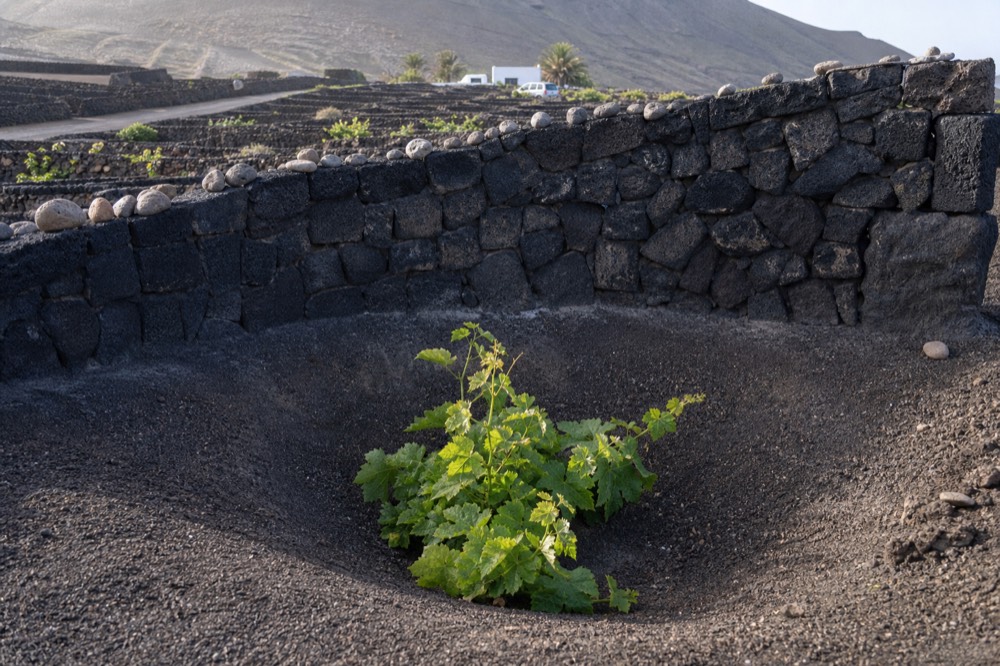
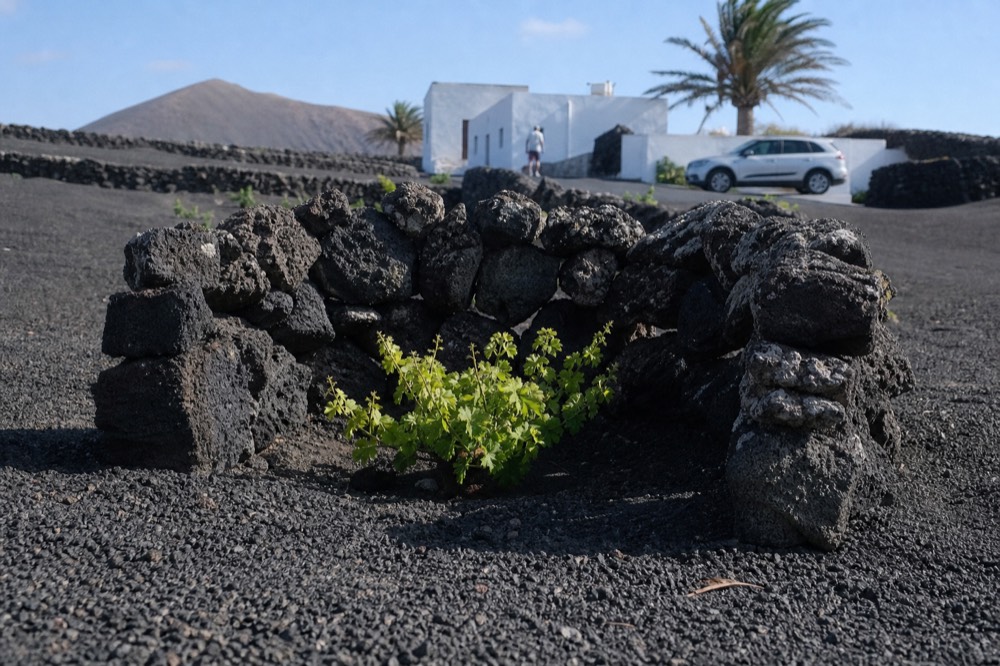
Each vine grows in a hoyo, a pit about three metres across and two to two and a half metres deep, dug through the lapilli until it reaches the buried pre-eruption soil where the roots take hold. A half-circle dry-stone wall, the zoco, is then built around the pit's north side to shield the vine from the north-northeasterly trade winds, which is why every wall in the valley faces the same way.
The vocabulary is worth getting right because bodega staff use it and most travel content does not. The pit is the hoyo. The stone windbreak is the zoco. The ash layer itself is lapilli, also called picón or rofe. The whole system of growing under a layer of ash is enarenado, and the Plan Especial distinguishes natural enarenados, where the eruption laid the ash down, from artificial ones where farmers carted ash in, which are shallower, rarely more than fifty centimetres of brought-in rofe.
| Term | What it means | Where you see it |
|---|---|---|
| Hoyo | The pit dug down through the ash to the buried soil, about 3 m across and 2-2.5 m deep | Every vine pit in the valley |
| Zoco | The dry-stone half-circle windbreak built on the pit's north side | The low stone arcs beside each vine |
| Picón / rofe / lapilli | The volcanic ash layer that blankets the ground | The black gravel covering everything |
| Enarenado | The overall system of growing under an ash layer, natural or carted in | The whole La Geria landscape |
What the picón does, per the appellation's own technical specification, is three things: it lets the island's scarce rain soak straight through instead of running off, it cuts evaporation from the soil beneath, and it regulates soil temperature. It also suppresses weeds, which is why the vineyards look raked and bare. A popular claim that the ash "collects dew from the air" is not in the specification and is best left out of any serious description.
The whole system is arid-land farming at its limit. The DO's own spec puts mean annual precipitation below 150 mm, with practically no rain between June and August, and classifies the climate as desert under the Lang index. For the full mechanics of ash viticulture, see our volcanic ash growing guide.
How Long Does The Drive Take From Each Resort?
From Puerto del Carmen the heart of La Geria is about 14 km and 17 minutes away; from Playa Blanca about 24 km and 25 minutes; from Costa Teguise about 28 km and 29 minutes. Every major resort on the island sits inside half an hour of the wine region, which is why a La Geria visit is routinely a morning or an afternoon rather than a full-day commitment.
Those figures are routing estimates over OpenStreetMap data, computed to Bodega La Geria at the valley's centre, not official published distances, so treat them as approximate. What they add up to is simple: no resort is badly placed for wine country. The only real planning variable is traffic and light, not distance. Morning light across the ash is harsh and flat; late afternoon gives the pits long shadows and makes the zocos readable from the road.
The drive itself has had recent attention. The LZ-30 between Teguise and Mozaga, almost seven kilometres of it, was resurfaced under a contract signed in March 2025, with new markings and signage, continuing earlier repairs around Uga and Masdache. Do not assume the whole road is new surface, only that stretch. The road also closes occasionally for island events, including the Romería de Los Dolores in September and the Ironman in May, so it is worth checking for announced closures before you drive it on a festival date.
One thing the drive does not pair easily with is Timanfaya. Montañas del Fuego now sells no tickets at the gate at all: CACT's own FAQ states tickets must be bought online in advance, with a chosen date and time slot, and arrival fifteen minutes early. Adult entry is €30. A casual "winery then volcano" afternoon now has to be built around a fixed slot, and no operator on our roster sells a Timanfaya day with a real tasting attached. Our wine and volcano tours guide covers that combination honestly.
Is La Geria The Same As Hipotels La Geria?
No, and this trips up plenty of searchers, since the hotel and the wine region share a name. Hipotels La Geria is an all-inclusive hotel on the beachfront road at Puerto del Carmen, roughly 14 km from the wine region and named after it, nothing more. The wine region is the protected volcanic landscape along the LZ-30. If you are staying at the hotel, you are actually well placed for the region: the valley is about a 17-minute drive inland.
The confusion is understandable. The hotel borrows the region's name, it is the larger commercial entity in search results, and a traveller typing "la geria" into a map or search bar will meet the hotel before the landscape. Some content even mixes the two up entirely, placing wineries at the beach.
The disambiguation cuts both ways, usefully. Staying at the hotel puts you at the shortest drive of any resort to the bodegas. Staying elsewhere on the island costs you only minutes more. And if your interest is the wine rather than the room, the Lanzarote Wine Tours roster covers every format from a 90-minute tasting to a six-hour four-winery day, all with pickup options in the driven tours.
What Is The Best Way To See The Region?
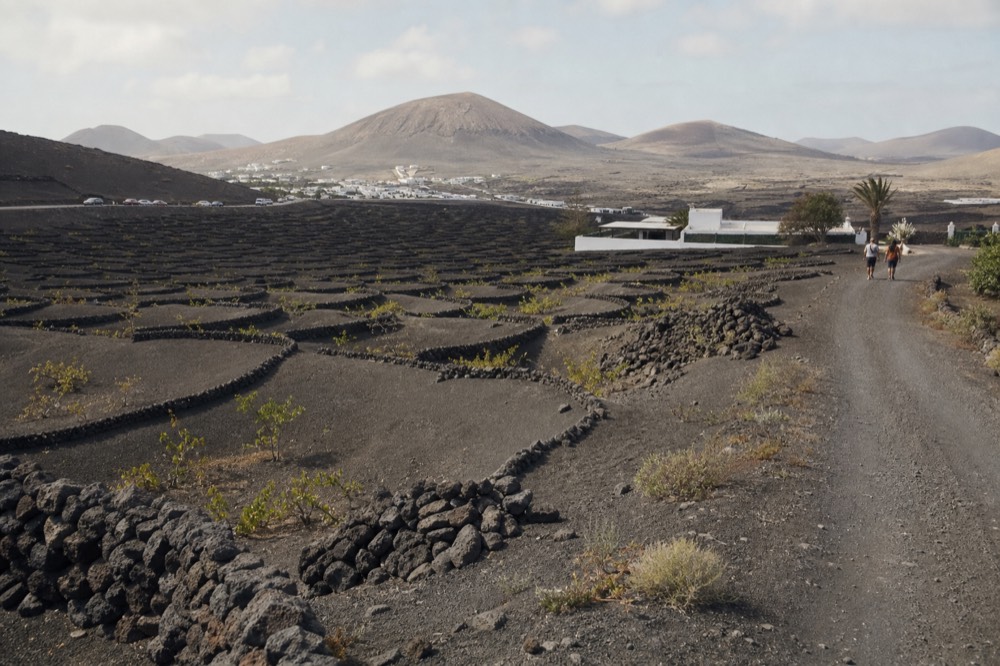
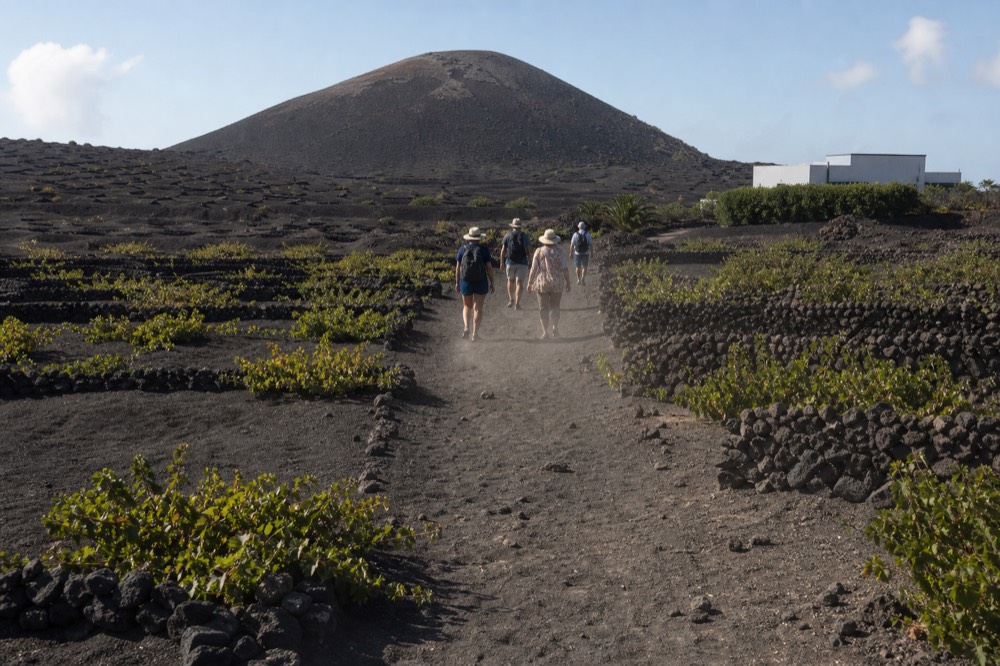
On foot, from a bodega terrace, or through a windscreen, depending on what you want from it. A guided hike of four hours covers the volcanoes and vineyards with a wine and cheese tasting at the end, limited to ten people, from $55. A driven multi-winery tour handles the logistics and the drink-driving question. A self-drive day is perfectly workable if one person stays on soft drinks.
That last point deserves plain language. Spain's general breath-alcohol limit is 0.25 mg/l, lower than the UK's 0.35, and a tasting flight across three bodegas will not leave most people confidently under it. That is the honest, sourced reason driven tours exist here, not manufactured urgency. The limits are published in the Reglamento General de Circulación, and the criminal threshold sits at 0.60 mg/l in breath.
For the on-foot option, the small-group hike through volcanoes and vineyards is the standout: 4.9 across 211 reviews, with wine and cheese included and pickup in the price.
For the driven option, the three-winery tour visits three bodegas with six wines and a goat-cheese tasting, capped at eight travellers, from $105. It is the cleanest answer for anyone who wants breadth without a hire car.
Seasonality matters less here than in most wine regions, because the vines are evergreen-ish and the landscape is the draw year-round. The harvest starts in July, in 2025 on 16 July, and the traditional vendimia events in mid-August bring camel-drawn grape processions and open-air tastings to the valley. For the full calendar, see our when to visit Lanzarote wine country guide.
Is La Geria Worth The Trip On Its Own?
Yes, and it is arguably the single most distinctive landscape in the Canary Islands. It is a protected landscape under Canarian law since 1987 in its first form and 1994 in its current one, and the island's growing system was added to the FAO's Globally Important Agricultural Heritage Systems list in 2025. Very few places on earth combine a live appellation, an active agricultural system and a landscape this visually alien.
The FAO listing, registered as "Agricultural Systems in Jable and Volcanic Sands in Lanzarote Island, Spain", covers the island's ash and sand dry-farming systems rather than La Geria by name, so treat it as recognition of the method, not a heritage stamp on the valley. The protection that does attach to the valley itself is the Paisaje Protegido de La Geria, 5,255 hectares across five municipalities.
There is also a live policy story. About 15 per cent of the 1,368 hectares under cultivation inside the protected space, some 237 hectares, was reported abandoned in mid-2025, and the Cabildo paid out 627,116 euros to 342 beneficiaries that year to keep the hoyo cultivation maintained. The vineyards you drive past are held open by hand and by subsidy, which is worth knowing before you call them a tourist backdrop.
A free stop that frames all of this: the Casa Museo del Campesino, the Cabildo's tribute to the island's farming knowledge with César Manrique's Fecundidad sculpture, is free entry and sits right at the LZ-30's Monumento al Campesino end. Our free things to do in wine country guide lists more.
Whichever way you choose to see it, these three tours are the strongest fits for the region itself.
These are the questions readers ask most about La Geria: where it is, whether the hotel and the wine region are the same place, why the vines grow in pits, and how many wineries you can actually visit once you are there. Each answer below is short, factual and drawn from the same verified sources as the guide above.
Common Questions About La Geria
Where Is The La Geria Wine Region Located?
In south-central Lanzarote, along the LZ-30 road between the Monumento al Campesino junction near San Bartolomé and Uga. It is a protected landscape of 5,255 hectares across the municipalities of Tinajo, Yaiza, Tías, San Bartolomé and Teguise, bordering the Parque Natural de Los Volcanes.
Does Lanzarote Have Vineyards?
Yes. Roughly 1,900 hectares are registered under the island's Denominación de Origen, worked by about 1,860 growers and 41 registered bodegas. La Geria is the most famous part of the appellation, but the DO legally covers the whole island.
Is La Geria The Same As Hipotels La Geria?
No. Hipotels La Geria is a beachfront hotel in Puerto del Carmen that shares the region's name. The wine region is about 14 km inland from it. Staying at the hotel actually puts you at the shortest resort drive to the bodegas, around 17 minutes.
Can You Drive Through La Geria Yourself?
Yes, the LZ-30 is a public road and the valley is free to drive. Bodega visits range from free walk-around access at Rubicón to paid guided tours. Remember Spain's breath-alcohol limit of 0.25 mg/l is lower than the UK's, so plan a driver or take a driven tour.
Why Do The Vines Grow In Pits?
Because the eruptions of 1730 to 1736 buried the farmland in volcanic lapilli. Farmers dug pits about three metres across and two to two and a half metres deep to reach the buried soil, and built half-moon stone walls, zocos, to shield each vine from the north-northeasterly trade winds.
How Many Wineries Can You Visit In La Geria?
The main visitable bodegas on or near the strip are El Grifo, Los Bermejos, Martinón, Bodega La Geria, Rubicón and Stratvs. No official count of visitor-open bodegas is published; 41 bodegas are registered with the DO, which is a different thing.