How Lanzarote Grows Wine In Volcanic Ash: Picon, Hoyos And Zocos
Lanzarote's vines do not grow in rows. They grow one to a pit, in hollows dug by hand through six years of eruption debris, behind dry-stone walls that all face the same direction. This is how the system works, why yields are a fraction of a normal vineyard's, and why that shapes the price of every bottle.
Short answer
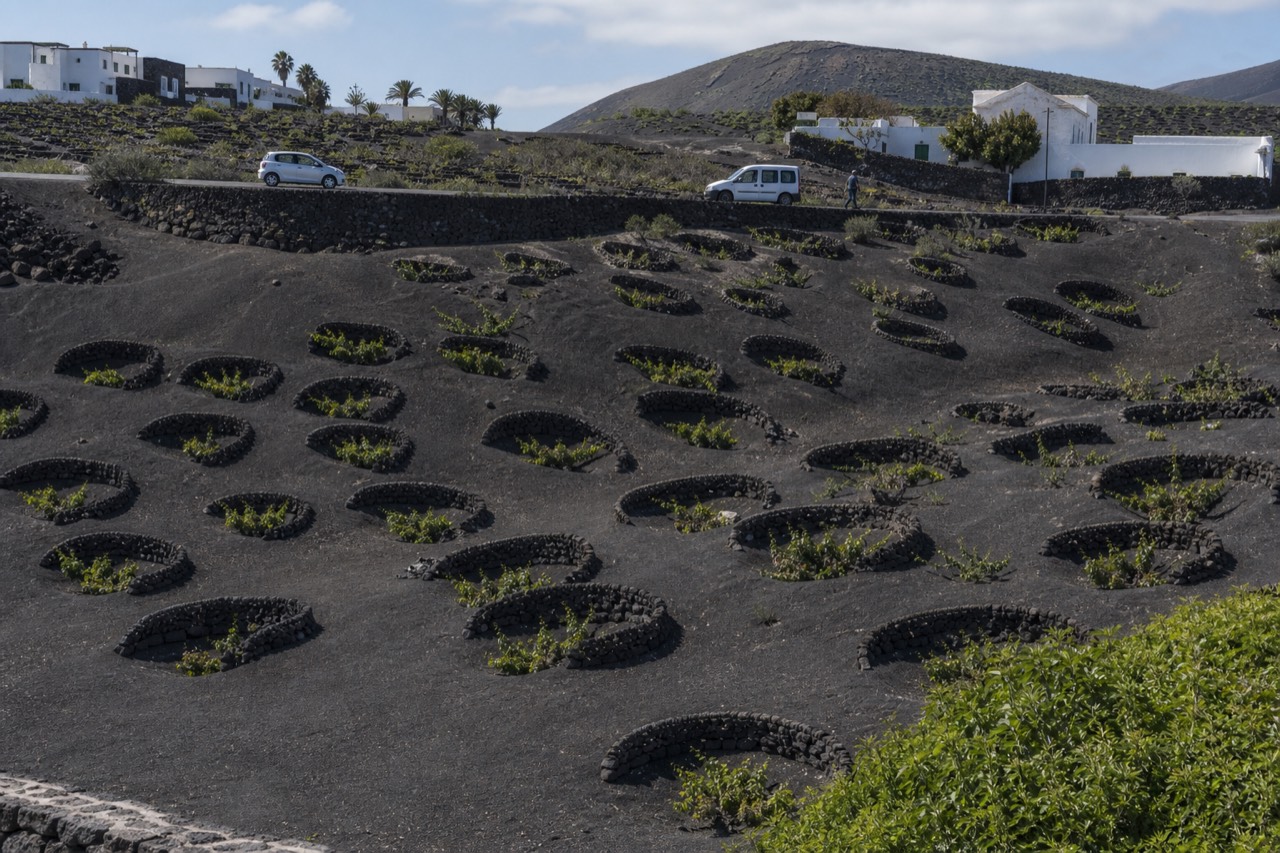
Lanzarote grows wine in pits called hoyos, roughly 3 m across and 2 to 2.5 m deep, dug through volcanic picon ash to the buried soil. Half-moon stone walls called zocos shield each vine from the north-northeasterly trade winds. The deepest-ash zone carries about 36 pits per hectare, and yields run near 1,000 kg/ha against a legal ceiling of 7,000.
Why Does Lanzarote Grow Wine In Volcanic Ash At All?
Between 1730 and 1736, six years of eruptions buried Lanzarote's farmland under lava and ash, and the island's farmers answered by digging down through it. Where lava ran, the land was lost for good; where the pyroclastic blanket of lapilli fell, they cut pits through the ash to the old soil and replanted. That adaptation became DO Lanzarote's viticulture, and it still fills the valley of La Geria today.
The eruptions that created this system are a matter of record. The DO's own product specification ties the vineyards directly to the zones near the eruption cones, "especially those that took place between the years 1730 and 1736", and the Cabildo's centres describe the same six years as the event that "transformed an essential part of Lanzarote". What the specification adds is the mechanism: lava destroyed, but ash could be reclaimed, with the technique of the hoyos.
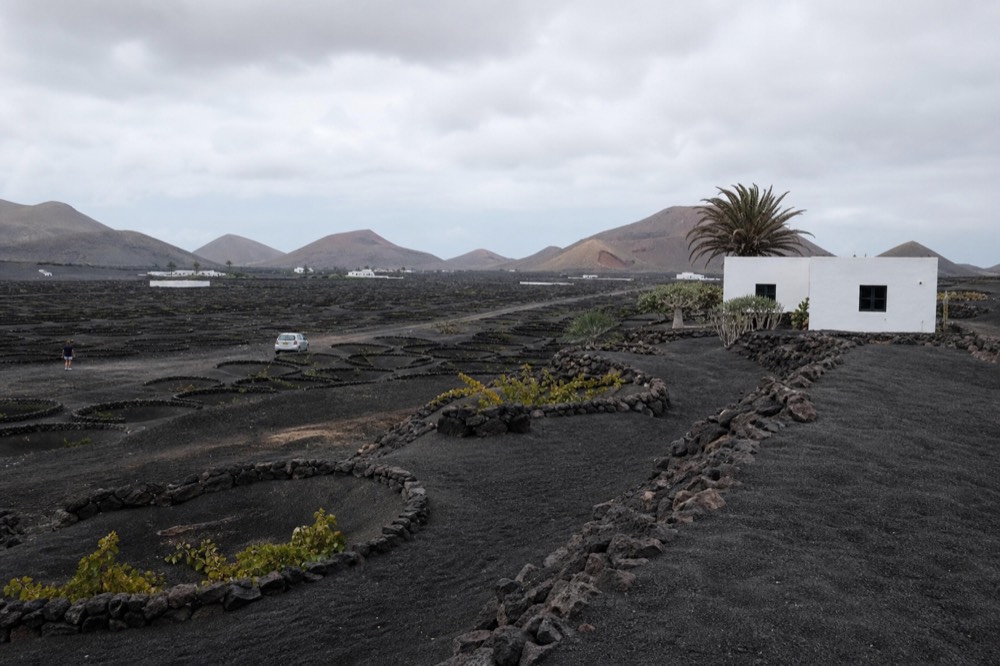
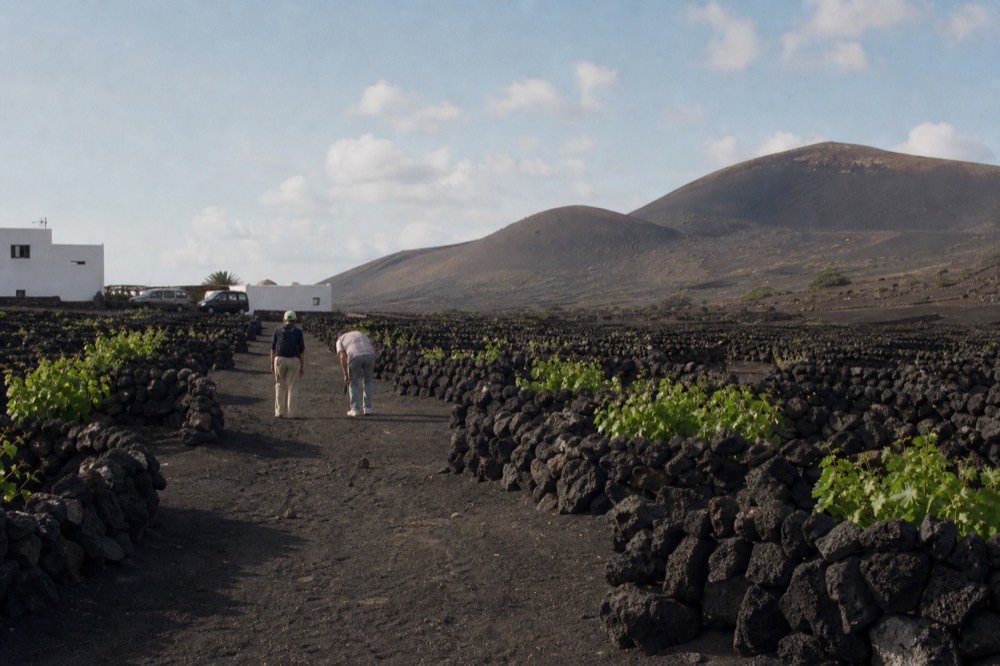
The result is a vineyard that looks like nothing else in Europe. Instead of trellised rows, you see a black plain dotted with craters, each holding one or a few vines, each ringed on its northern side by a low crescent of stone. It is strange enough that the island's growing system was added to the FAO's Globally Important Agricultural Heritage Systems list in 2025, registered as "Agricultural Systems in Jable and Volcanic Sands in Lanzarote Island, Spain" (FAO GIAHS listing).
If you want the full picture of the protected landscape these vineyards sit in, our La Geria wine region guide covers the geography and the visiting practicalities. This page stays on the farming itself: the ash, the pits, the walls, and the arithmetic that makes the wine scarce.
What Is Picon And What Does It Actually Do?
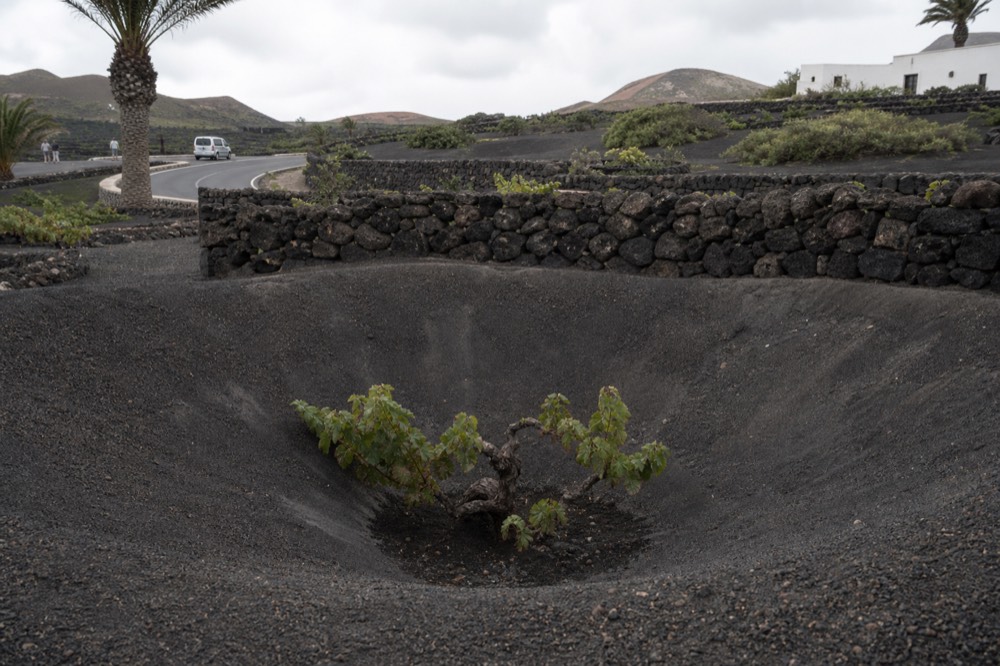
Picon, also called lapilli or rofe, is the layer of volcanic gravel that fell as pyroclastic rain and blanketed the ground. The DO's own specification credits it with three functions: it lets scarce rain soak straight through instead of running off, it cuts evaporation from the soil beneath, and it keeps soil temperature steady. It also suppresses weeds. On an island with under 150 mm of rain a year, that mulch is the whole game.
The specification is unusually plain about the climate this system has to survive. Aridity is described as the most relevant feature of Lanzarote's climate; almost no rain falls between June and August; the mean temperature sits around 20 °C with day-night swings that can reach 17 °C in a single day, which the text calls characteristic of desert regions. The island is too low and too flat to catch the trade-wind inversion, so the sea of cloud that waters the higher Canary Islands never breaks over it.
One claim you will read almost everywhere else does not survive contact with the primary source. Many pages say the picon "collects dew" or "harvests moisture from the air overnight". The appellation's own technical specification says nothing of the sort: it credits the ash layer with fast rain infiltration, reduced evaporation and soil-temperature regulation, and no measured condensation figure exists anywhere in the official record. The mulch is remarkable enough without the dew story.
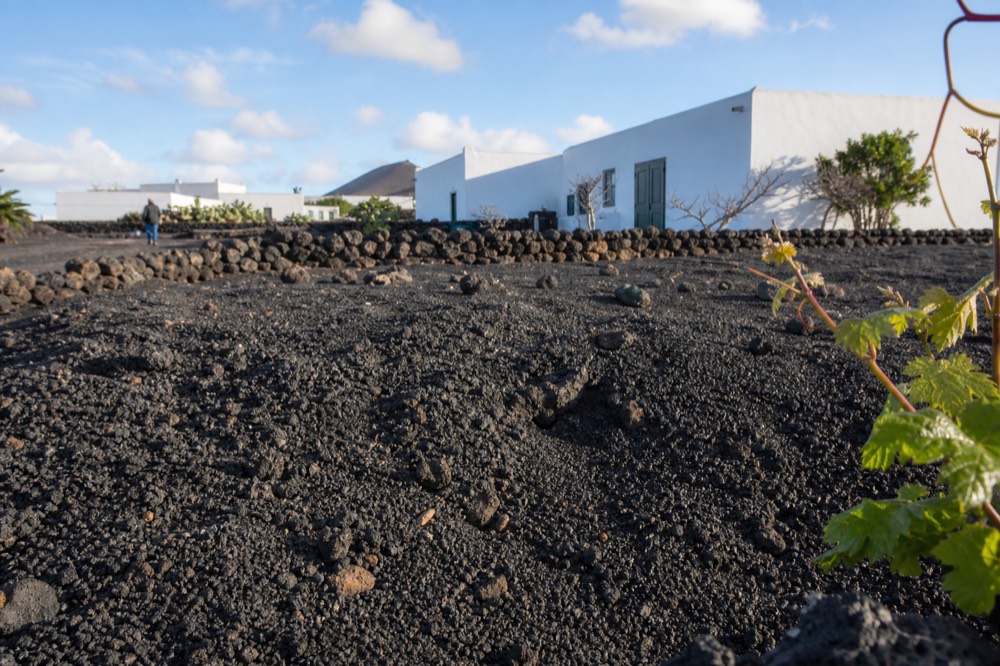
That matters for a visitor, because it tells you what you are actually looking at. The black plain is not barren ground the vines tolerate; it is a hand-laid growing medium, in the natural enarenados where the eruption left the ash and in the artificial ones where farmers carted it in. In the artificial enarenados the ash layer is thin, rarely more than half a metre deep, which is why the pits there are shallow and the planting denser.
How Are The Hoyos Dug, And Why One Vine Per Pit?
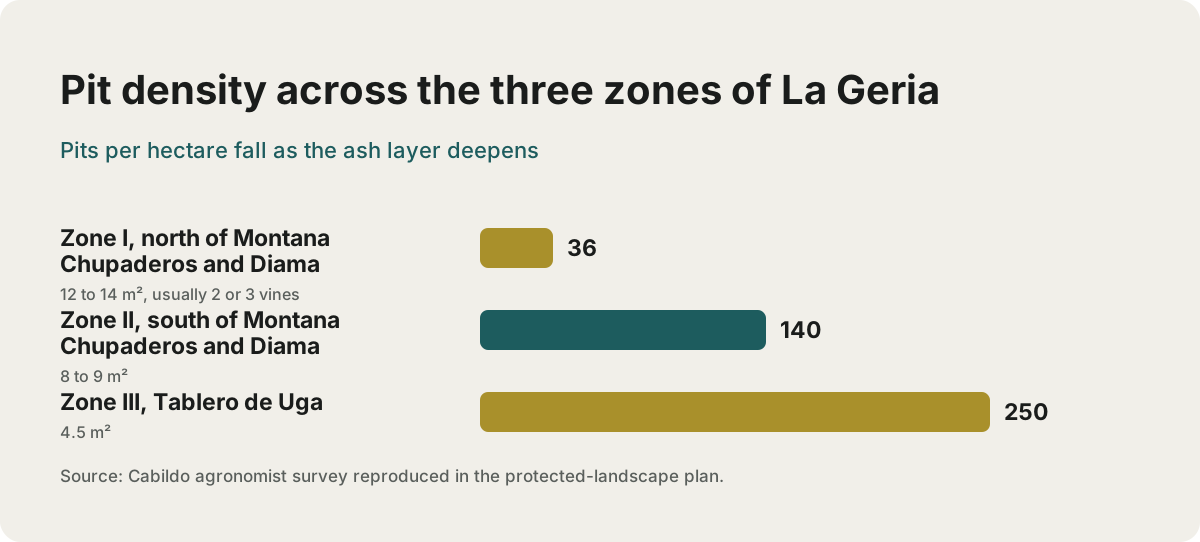
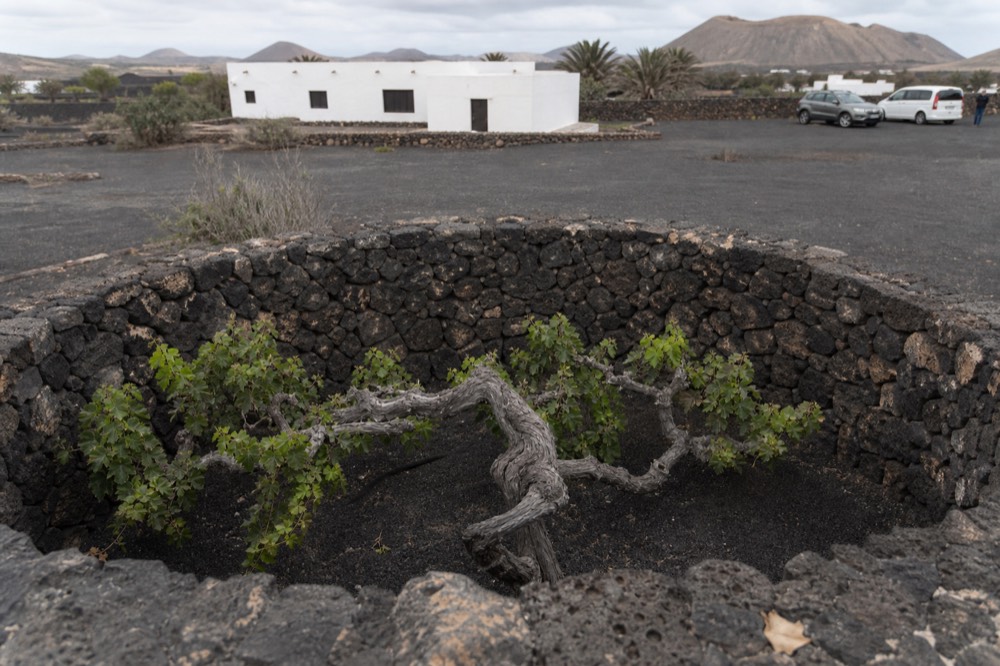
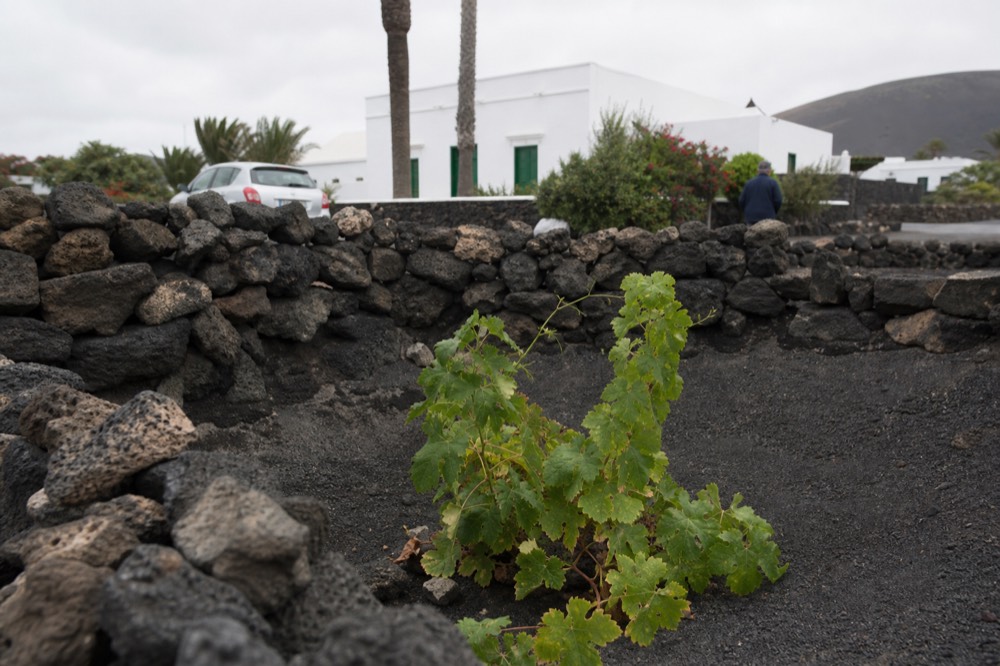
A hoyo is a pit roughly 3 metres across and 2 to 2.5 metres deep, dug by hand through the ash until it reaches the pre-eruption soil buried below. The vine is planted down in that old soil and roots deep. In the deepest-ash zone of La Geria there are only about 36 pits per hectare, each holding two or three vines, against thousands of plants per hectare in a conventional vineyard.
Those dimensions come straight from the DO's product specification, which describes the opening of a pit of about 3 m diameter by 2 to 2.5 m depth down to the surface of the buried soil, with deep root systems below. The density figures come from a survey by the Cabildo's own agronomist, reproduced in the protected-landscape plan, which divided La Geria into three zones by pit size.
| Zone of La Geria | Pits per hectare | Surface of each pit |
|---|---|---|
| Zone I, north of Montana Chupaderos and Diama | 36 | 12 to 14 m², usually 2 or 3 vines |
| Zone II, south of Montana Chupaderos and Diama | 140 | 8 to 9 m² |
| Zone III, Tablero de Uga | 250 | 4.5 m² |
The logic of the spacing is the ash itself. Where the layer is deepest, reaching the buried soil means moving the most rock, so each pit is big, the vines few, and the landscape at its most lunar. Around Masdache, where the ash is thinner and artificial enarenados dominate, density rises again. Trench planting, a more recent introduction, can reach 950 plants per hectare, but that is not the classic La Geria picture.
Every one of those pits was opened by hand, and the maintenance is manual too, which is why the Cabildo runs a subsidy scheme to keep the hoyo cultivation from being abandoned: 627,116 euros was paid out to 342 beneficiaries under the scheme by late December 2025. About 15 per cent of the 1,368 hectares under cultivation inside the protected landscape, some 237 hectares, was reported abandoned in mid-2025. The system is beautiful and it is expensive to keep alive.
The three experiences above are the ones that put you closest to this landscape: a small-group hike through the pits with wine and cheese at the end, a natural-wine tasting with a Canarian pairing plate, and a three-hour visit to a family winery on the lava flow itself. All three can be cancelled free, which is table stakes on this island rather than a differentiator.
Why Do The Zoco Walls All Face The Same Way?
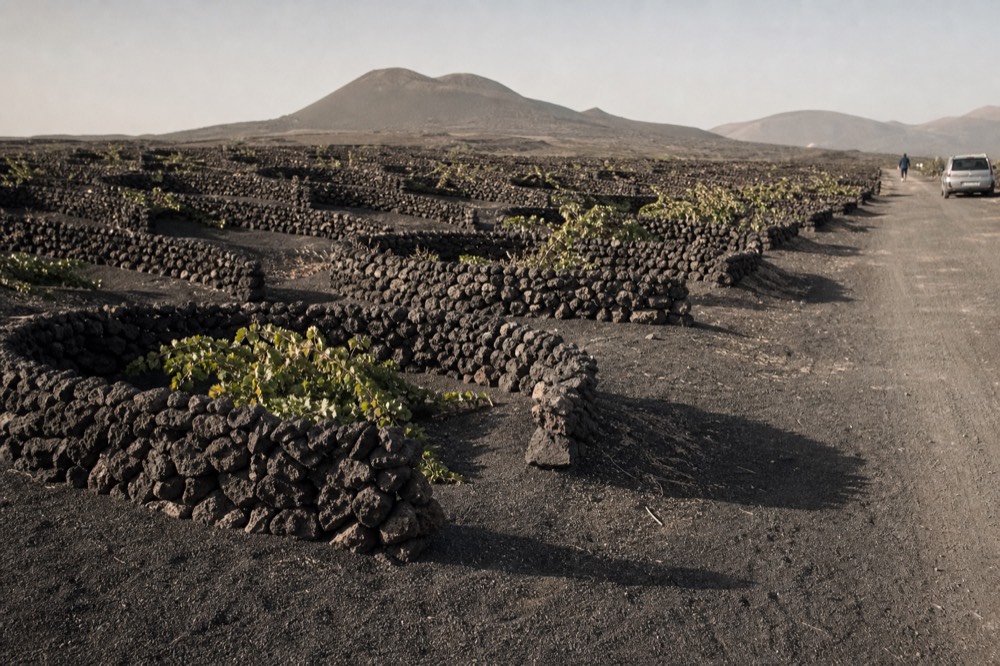
The zoco is a dry-stone semicircle built around part of each pit, and it faces the same way across the whole valley because the wind does. The protected-landscape plan states it directly: the walls protect the vine from wind coming from the north-northeast, which is the direction of the trade winds. That is why the crescents never form a full ring.
This is the detail you can verify from the roadside without a guide. Stand anywhere along the LZ-30 and look across the vineyards: every stone crescent opens toward the south-southwest and closes toward the north-northeast. The plan's own wording says the zocos surround only part of the pit, in such a way as to protect the vine from wind from the N-NE, and calls it the solution the Lanzarote farmer found for wind protection.
A full ring would waste stone on three sides that do not need it. The half-moon gives maximum shelter where the wind actually comes from, using the minimum of material, on an island where every stone had to be cleared before anything could be planted. It is dry-stone construction, no mortar, and the walls are rebuilt by hand as they weather.
The wind is not a minor factor here. It is strong enough that an outdoor wine festival at a bodega, Sonidos Liquidos at Bodega La Geria on 6 June 2026, was cancelled outright because gusts had already exceeded 75 km/h and the forecast said worse. Anything growing unprotected on this island takes a beating, and the zoco is the answer the island settled on two and a half centuries ago.
Why Are The Yields So Low?
La Geria yields roughly 1,000 kg of grapes per hectare, against a legal ceiling of 7,000 kg per hectare that the DO permits. That is about one seventh of what the appellation allows, and a small fraction of a conventional region's output. The gap is the arithmetic behind the price of every bottle of Lanzarote volcanic wine.
The 1,000 kg/ha figure comes from the protected-landscape plan, using data supplied by the Consejo Regulador for the 690.88 hectares then being actively farmed by registered owners inside La Geria. The 7,000 kg/ha ceiling, equal to 51.80 hl of finished wine per hectare, comes from the DO's current product specification, which also caps planting density at 3,000 vines per hectare and extraction at 74 litres of must per 100 kg of grapes.
| Measure | La Geria reality | DO Lanzarote rule |
|---|---|---|
| Yield | about 1,000 kg/ha | maximum 7,000 kg/ha |
| Planting, deepest-ash zone | about 36 pits per hectare | maximum 3,000 vines per hectare |
| Vines per pit | 2 or 3 in the big Zone I pits | not fixed by rule |
Bodegas Los Bermejos corroborates the picture on its own site, describing pits reaching 4 metres deep and 6 metres across in places, densities from under 200 to 800 plants per hectare, and overall yields varying from 500 to 1,500 kg per hectare. One winery's numbers, but they point the same way as the official ones.
The scarcity is compounded by the weather. The 2025 campaign brought in 843,000 kg of grapes and produced 1,502,656 bottles, one of the smallest harvests in years, after 3.3 million kg in 2023 and 1.3 million kg in 2024. Against that, the island recorded 3,455,200 tourist arrivals in 2025. There are vastly more visitors each year than the DO can produce bottles for, and roughly 98 per cent of what it does sell never leaves Spain.
Why Has Phylloxera Never Reached Lanzarote?
The Canary Islands were free of phylloxera until the first case was confirmed on Tenerife in late July 2025, protected by a 1987 phytosanitary Order that barred vine-plant material from entering the archipelago. That is why the islands still hold pre-phylloxera, centuries-old vines. The outbreak has stayed on Tenerife: the 2026 survey campaign ran 1,373 inspections on Lanzarote and found nothing.
The 1987 Order is quoted in the Gobierno de Canarias' own announcement of the Tenerife detection, which also describes the Canaries as one of the few zones of Europe conserving pre-phylloxera centenarian vines. The follow-up is the part almost no coverage carries: the 2026 campaign completed 4,435 inspections across the archipelago, found four new positives, all confined to the demarcated zone on Tenerife, and found no case anywhere else. Lanzarote, with 1,373 of those inspections, remains clean.
What you can honestly say on the island is that the wineries' own old vines are real and documented. El Grifo says 19th-century Moscatel vines still stand on its estate. Rubicon calls its estate vines century-old inside the protected landscape. Stratvs describes its 52 hectares in La Geria and 25 in Uga as century-old vines. Each is the winery's claim about its own property, and each is checkable on the winery's own site.
One claim that circulates widely is that Lanzarote's vines are ungrafted or grown on their own roots. No source in the official record states Lanzarote's rootstock practice specifically. What is documented concerns the archipelago as a whole: its pre-phylloxera centenarian vines and the 1987 import ban on vine material, and that is where the record stops.
Which Grapes Grow In The Ash?
Malvasia Volcanica is the island's signature grape and the preferred white variety in the DO's specification, alongside Gual, Diego and others; Listan Negra leads the preferred reds. Malvasia Volcanica came in first at about 70 per cent of the 2022 harvest, per Consejo Regulador figures reported locally, and it is traditionally the first variety into the winery each July.
The specification divides its variety list into preferred and merely authorised, and the distinction is worth seeing in full because it explains what is actually in the glass.
| Category | Preferred varieties | Authorised varieties (selected) |
|---|---|---|
| White | Malvasia Volcanica, Gual, Diego (Vijariego blanco), Albillo criollo, Moscatel de Alejandria, Verdello | Listan blanco, Breval, Burrablanca, Pedro Ximenez, Torrontes |
| Red | Listan Negra, Negramoll, Malvasia Rosada, Tintilla | Syrah, Tempranillo, Cabernet Sauvignon, Merlot, Pinot Noir, others |
Two figures float around for Malvasia's share and they measure different things, so keep them apart. The harvest share, about 70 per cent of the 2022 crop, comes from Consejo Regulador data via local press. The planted share inside La Geria, from the older landscape-plan census, puts Listan Blanco first at 45 per cent and Malvasia at 40 per cent of the 690.88 hectares. One is what gets picked, the other is what is in the ground; neither contradicts the other, and quoting the harvest share as a planted share is the classic error.
The plan adds a detail that rewards a slow drive: Malvasia predominates in the oldest growing zones, where the ash layer is highest and the pits biggest. The deepest-ash, lowest-density vineyards you photograph from the roadside are, disproportionately, the Malvasia vineyards.
When Is The Harvest, And Why Is It So Early?
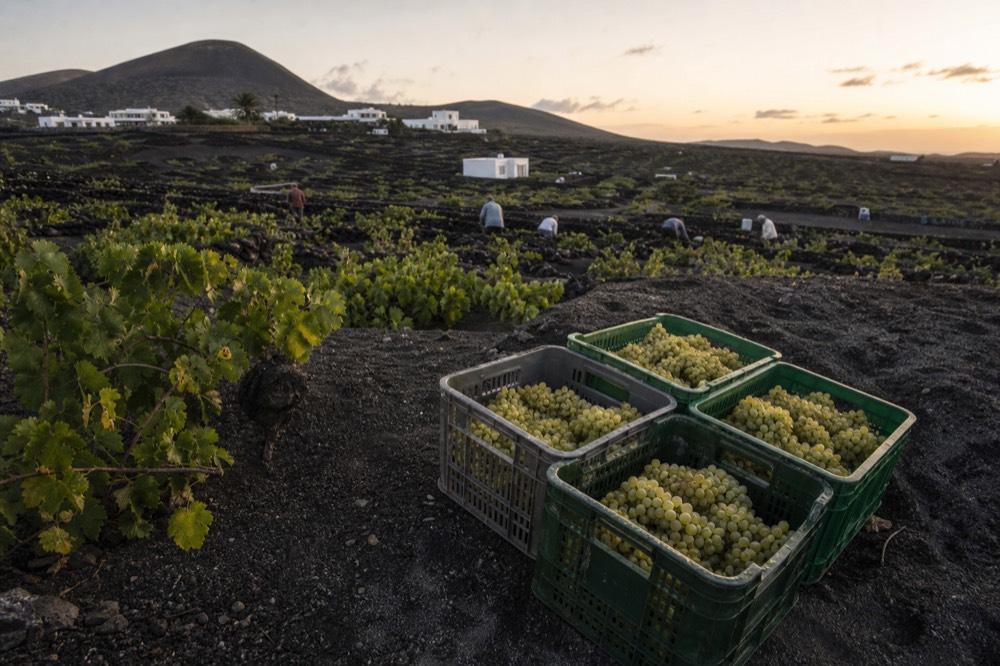
The harvest starts in July. In 2025 the first Malvasia Volcanica came in on 16 July; in 2026 picking began in the first week of July, again making the island, in the words of repeated press coverage, the first wine region in Europe to start. The early start is driven by the desert climate: the vines wake early and the summer heat arrives early.
"Europe's earliest harvest" is a claim this site attributes rather than asserts, because the sourcing is press, not an official body. The dates themselves are solid. The 2025 opening, by Bodega David Fernandez on 16 July, was followed within days by Volcan del Sol, Vega de Yuco, El Raso and Bodega Olivina, with El Grifo and Cohombrillo starting on 21 July. In 2026 the same bodega, David Fernandez, and Jable de Tao opened the campaign in the first week of July, followed by El Grifo, whose first pressings went to its Brut sparkling.
The 2026 campaign is the one worth watching. About 900,000 kg had been picked by early August, and the Consejo Regulador's forecast of 2 September 2026 put the final total above three million kilos, roughly triple the 843,000 kg of 2025, with the fruit described as being in excellent condition. It is a forecast, not a final figure, and the harvest had not closed when it was made.
If seeing the harvest matters to you, our when to visit Lanzarote wine country guide lays out the whole calendar, including the traditional vendimia events that ran in La Geria on 14 and 15 August 2026 and the Consejo Regulador's Semana Malvasia, scheduled for 2 to 8 November 2026.
Does The Ash Method Change What Is In The Bottle?
It shapes it at every step: low yields concentrate the fruit, the desert climate gives a big day-night temperature swing, and the deep rooting into buried soil pulls from a pre-eruption profile. The strongest external evidence is competitive: Vega de Yuco's Princesa Gara 2022, a Malvasia Volcanica aged on lees, took a Silver medal, 90 to 94 points, at the Decanter World Wine Awards 2026.
That Decanter result is the cleanest single answer to whether any of this translates into quality: a named wine, a named grape, an international jury in London, and a numeric score band, all from 2026. The same winery's Princesa Fayna Brut Nature 2019 took a Bronze at the same competition. For the taste side of the story, what the wines actually smell and taste like, our what does volcanic wine taste like piece takes over from there.
The honest caveat is that "volcanic" is not a guarantee. At the Canaries' own official 2026 competition, the top wines both came from Tenerife, not Lanzarote. An island that admits that and then explains what its own terroir does differently is more credible than one that does not.
The most direct way to test the claim on the day is a tasting built around exactly these wines. The Natural Wines, Canarian Pairing experience pours natural wines from this growing system with an artisanal cheese and seasonal Canarian plate, in groups of ten people or fewer, from $94, rated 5 out of 5.
Seeing The System For Yourself: Walking La Geria
You can understand the hoyos from the roadside, but you only understand the scale of the work standing inside one. A guided walk through the vineyards and volcanoes of La Geria puts you between the pits, on the ash, with the zocos at head height, and the better ones end with a wine and cheese tasting that connects the landscape to the glass.
The Small-Group Hike, Wine And Cheese experience does exactly that: four hours through volcanoes and vineyards with pickup included, a wine and cheese tasting at the end, limited to ten participants, from $55 and rated 4.9 from 211 reviews. It is the tour this site recommends most often for readers who want the viticulture rather than just the tasting room, and it is the one we would point anyone at who has read this far.
For a slower, winery-centred version of the same story, the Family Winery, 3-Hour Lava Flow visit spends three hours at a family bodega on the lava flow itself, with snacks, cheese and chocolate tastings, from $65, rated 5 from 7 reviews. And if you would rather drive the valley than walk it, our driving the La Geria wine route guide covers the LZ-30, the wineries on it and the one planning rule that now matters most: Timanfaya, further west, sells no tickets at the gate at all and requires a pre-booked time slot, so a casual "winery then volcano" afternoon no longer works the way it used to.
One practical note before you go. Spain's drink-drive limit is 0.25 mg per litre of breath, lower than the UK's 0.35, and a tasting flight in La Geria will not leave most people confidently under it. That is the plainest, most honest reason a guided walk or a driven tour beats a self-drive afternoon, and it needs no invented urgency. You must also be 18 to taste, and in the Canary Islands there is no parental-consent exception.
Whatever shape your visit takes, the landscape rewards knowing what you are looking at. The half-moons all face the wind. The craters are hand-dug. The black plain is a mulch, not a wasteland. Lanzarote Wine Tours exists to make that kind of reading available before you book anything, because a valley this strange deserves more than a photo stop.
These are the questions readers ask most about the hoyos, the picon mulch and the zoco walls, answered from the same official sources as the article above: the DO's product specification, the protected-landscape plan, and the Consejo Regulador's own harvest and survey figures. Each answer keeps to what those documents actually say.
Common Questions About Growing Wine In Volcanic Ash
What Is Picon?
Picon, also called lapilli or rofe, is the layer of volcanic gravel that fell as pyroclastic rain during the eruptions of 1730 to 1736. It acts as a mulch: the DO's specification credits it with fast rain infiltration, reduced evaporation and steady soil temperature. It does not, despite the popular claim, collect dew from the air.
Why Are The Vines Grown In Pits?
The ash layer buried the island's original soil, so farmers dug hoyos, pits about 3 m across and 2 to 2.5 m deep, down to that buried soil and planted the vines in it. The vine roots deeply into the old profile while the ash above works as a protective mulch.
Why Do The Stone Walls Only Go Halfway Round?
The zocos are semicircular because the wind comes from one direction, the north-northeast trade winds. The official landscape plan states it directly: the walls protect the vine from N-NE wind, so a half-moon gives full shelter with the minimum of stone.
How Many Vines Per Hectare Are There In La Geria?
In the deepest-ash zone, about 36 pits per hectare, each usually holding two or three vines. Densities rise to 140 pits per hectare in Zone II and 250 in the Tablero de Uga. A conventional vineyard runs to thousands of vines in the same space.
Are Lanzarote's Vines Ungrafted?
No official source states Lanzarote's rootstock practice. What is on the record is that the Canary Islands were free of phylloxera until a first case on Tenerife in late July 2025, that the archipelago holds pre-phylloxera centenarian vines, and that 1,373 inspections on Lanzarote in 2026 found nothing.
Why Is Lanzarote Wine Relatively Expensive?
Yields run at about 1,000 kg per hectare against a legal ceiling of 7,000, every pit is dug and maintained by hand, and the 2025 harvest produced just 1,502,656 bottles for an island receiving about 3.45 million tourists a year. Scarcity plus labour is the price, and the 2026 rebound above a forecast 3 million kg may ease it slightly.