Which Is Nicer, Lanzarote Or Tenerife?
An honest comparison of Lanzarote and Tenerife for travellers who care about wine: landscape, appellations, crowds, driving and which island suits which trip.
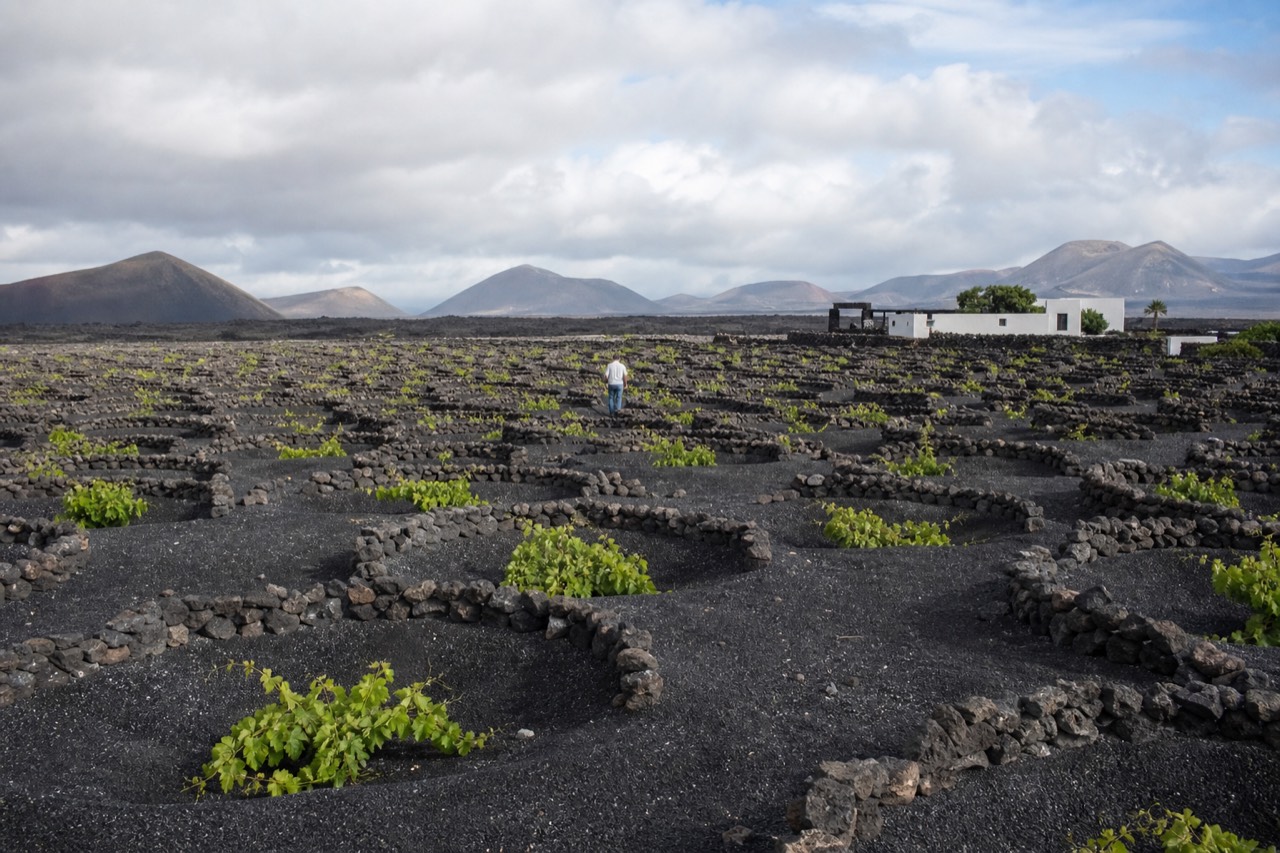
Which Is Nicer, Lanzarote Or Tenerife?
Neither island is objectively nicer: Tenerife offers more scale, more appellations and Spain's most visited national park, while Lanzarote offers a volcanic wine landscape that exists nowhere else on earth. If wine country is the point of the trip, Lanzarote wins on landscape; if variety is the point, Tenerife wins on choice.
The honest answer depends on what kind of holiday you are actually booking. These are the two most different islands in the Canaries, and the comparison gets muddled because most write-ups treat them as interchangeable sunshine destinations. They are not.
Tenerife is the big island, much larger, with two airports, two airports, Spain's tallest mountain and a wine industry spread across several separate appellations. Lanzarote recorded 3,455,200 visitors in 2025, has one airport, one island-wide wine appellation and a vineyard landscape that the FAO added to its Globally Important Agricultural Heritage Systems list in 2025. One is a continent in miniature. The other is a small, strange, unified thing.
The wine angle matters here because it cuts against the usual rankings. Tenerife is the Canary Islands' heavyweight on paper, with more vineyard area, more appellations and higher-altitude vineyards than anywhere in the archipelago. But the single most distinctive wine landscape in Spain, arguably in Europe, sits on Lanzarote, and it is the reason this site exists. If you are choosing between the two islands and wine is part of your reasoning, the trade-offs below are the ones that actually count.
Is Tenerife Or Lanzarote Better For Wine?
For wine specifically, Tenerife has the broader menu: several separate appellations, higher-altitude vineyards and the Canary Islands' current champion wines. Lanzarote counters with a single island-wide DO, roughly 84 per cent white wine, and a growing method, vines planted in hand-dug ash pits, that no other wine region copies.
Start with the uncomfortable fact, because a comparison that hides it is not worth reading. At the Canary Islands' own official competition, the Concurso Oficial de Vinos de Canarias 2026, the Best Wine of Canarias award went ex aequo to two Tenerife wines: Pico Cho Marcial Tinto, under DOP Islas Canarias, and Flor de Chasna Blanco Naturalmente Dulce, from DOP Abona. Tenerife took the archipelago's top prizes. That is the current state of play at the islands' most prestigious contest.
Lanzarote's answer is not medal count but singularity. The DO Lanzarote, recognised in 1993, covers the whole island: about 1,900 registered hectares, roughly 1,860 growers and 41 registered bodegas, per the Spanish agriculture ministry's 2023/24 DOP report. Around 84 per cent of what the DO sells is white wine, dominated by Malvasía Volcánica, and about 98 per cent of it is drunk inside Spain. Scarcity is real here: the 2025 harvest brought in 843,000 kilos of grapes, roughly a sixth of the entire archipelago's DOP crop that year, after Canary-wide DOP production fell 27 per cent to 4.84 million kilos.
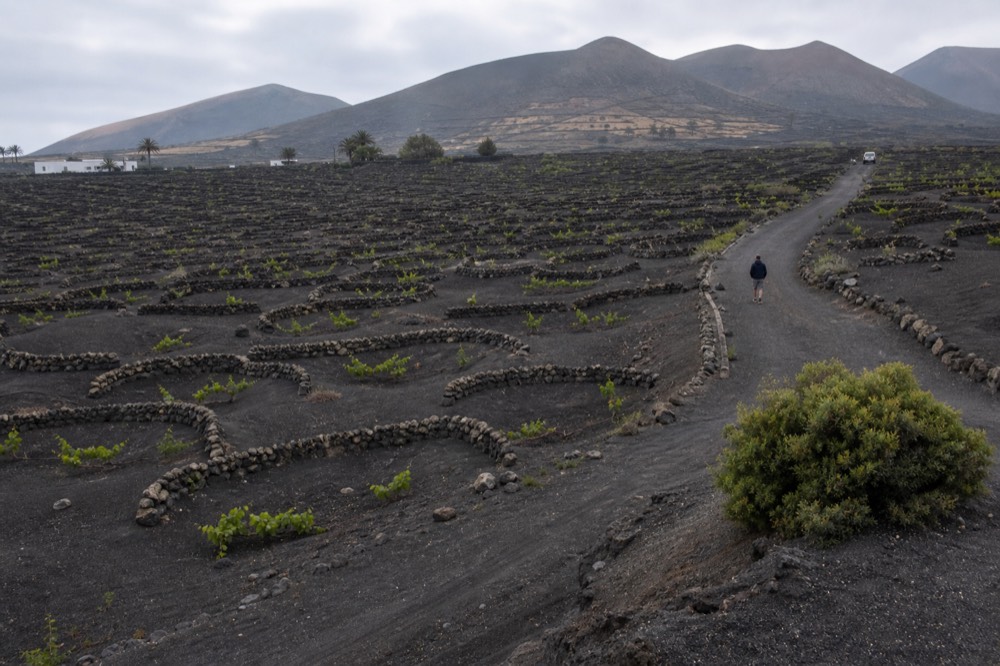
And then there is the landscape, which is not a marketing flourish. In the deepest-ash zone of La Geria there are about 36 vine pits per hectare, each one dug by hand through volcanic lapilli down to the buried pre-eruption soil, against thousands of vines per hectare in a conventional vineyard. Real yields run around 1,000 kg per hectare against a legal ceiling of 7,000. Tenerife's vineyards, some climbing the slopes of Teide's valleys, are beautiful and in many cases older in their rootstock story. Lanzarote's are unearthly. Whether "better" means better wine or a more extraordinary place to taste it is the whole question.
| Factor | Lanzarote | Tenerife |
|---|---|---|
| Wine appellations | One island-wide DO, recognised 1993 | Several separate DOPs, including Abona, Valle de Güímar and Tacoronte-Acentejo |
| Signature style | Volcanic Malvasía Volcánica whites, about 84% of sales | Wider range, including the 2026 Best Wine of Canarias winners |
| Vineyard landscape | Hand-dug ash pits with stone windbreaks in La Geria | Higher-altitude slopes, including Teide's valleys |
| 2025 harvest | 843,000 kg, vintage qualified very good | Part of a 4.84 million kg Canary-wide DOP crop |
| International recognition | FAO GIAHS listing for the growing system, 2025 | Best Wine of Canarias 2026, both top prizes |
If that table pushes you toward Lanzarote, the practical question is how to taste it well without spending your whole day on logistics.
Which Is Nicer, Lanzarote Or Fuerteventura?
Fuerteventura is the weakest of the three for a wine trip: it has no DO wine industry to speak of and its appeal is beaches, not vineyards. Between Lanzarote and Tenerife the choice stays the same, and Fuerteventura only enters the conversation for travellers prioritising coast over everything else.
People ask the Fuerteventura version of this question because the three islands often share a flight search, and the honest answer is that Fuerteventura is not competing on the same terms. It is a superb beach island, arguably the best in the archipelago for sand and water sports, but it is not a wine destination. There is no Lanzarote-style appellation economy, no vine-pit landscape, no string of bodegas along a wine road.
What Fuerteventura does share with Lanzarote is quiet. Both islands run at lower visitor volumes than Tenerife, and both feel less built-up. If your shortlist is really "quieter island with something interesting inland", Lanzarote is the one that delivers wine country; Fuerteventura delivers dunes. A day trip between the two is easy, since the ferry from Playa Blanca crosses to Corralejo regularly, so some travellers base on one and visit the other.
One practical note if you are staying in Playa Blanca and doing exactly that: no wine tour on the roster offers a Playa Blanca pickup, so plan your La Geria day as a drive or pick a tour with pickup further north. That is a small island reality worth knowing before you book a southern hotel on the strength of a wine itinerary.
That ferry link also shapes how the comparison plays out in practice. If you base in Playa Blanca, Corralejo is the natural first stop on Fuerteventura, which puts you close to the dune landscape rather than any inland scenery. Travellers who do cross for the day tend to go for the beaches and the town, not for anything resembling a wine itinerary, so it works best as a beach add-on to a Lanzarote trip rather than the other way round.
The split also matters for how you split your time. A wine-focused visitor will find the meaningful stops concentrated on Lanzarote, in and around La Geria, while Fuerteventura rewards a different kind of day entirely. Trying to force both into one short trip usually means shortchanging the wine side, so if vineyards are the reason you are booking, Lanzarote is the base that makes sense and Fuerteventura stays a side trip at most.
What Does Each Island Actually Look Like?
Lanzarote looks like nowhere else: black ash fields dotted with hand-dug vine pits and half-moon stone walls, all inside a protected landscape of 5,255 hectares. Tenerife is greener and far more varied, from laurel forest to Mount Teide, but its wine country is conventionally pretty rather than surreal.
The visual difference is the one travellers remember longest. Lanzarote's wine country, La Geria, is a protected landscape across five municipalities where each vine grows alone in a pit roughly three metres across and two to two and a half metres deep, shielded by a dry-stone semicircle called a zoco. The walls all face the same way because the trade winds do: they block the north-northeasterly blasts. From the LZ-30 wine road the whole valley reads as a single designed object, which is close to what it is, six years of eruptions between 1730 and 1736 followed by generations of farmers digging the land back.
Tenerife's scenery is bigger in every dimension. Teide dominates the island as Spain's tallest mountain, the laurel forests of Anaga sit in a biosphere reserve, and the island cycles through climates as you climb. Its vineyards sit on slopes and terraces that look like vineyards almost anywhere warm and mountainous, with the twist of black volcanic soil and some very old vines. Beautiful, yes. Singular, less so.
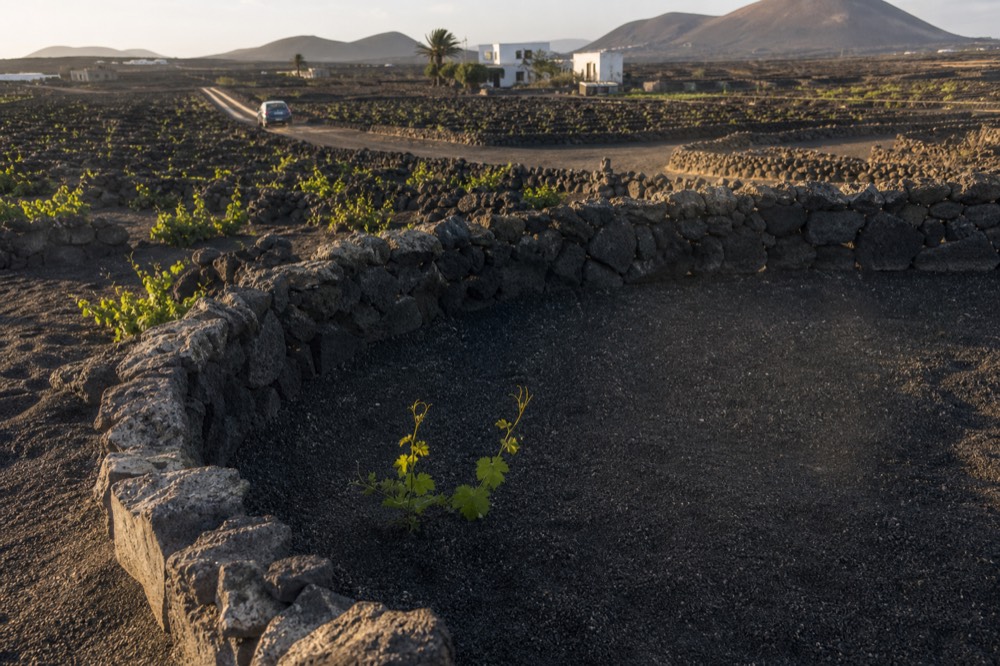
There is one more difference worth naming, and it is a fresh one. Lanzarote's volcanic dry-farming system, the ash and sand growing method behind those pits, was added to the FAO's Globally Important Agricultural Heritage Systems list in 2025, a recognition it earned precisely because the landscape is a working agricultural system rather than scenery. The details are on the FAO's own GIAHS page. Tenerife has nothing equivalent in its vineyards, and that is not a knock on Tenerife, it is just a different kind of island.
For photographers and slow drivers, this difference dictates how you should spend your time. On Lanzarote, the landscape rewards stopping: a single pit with its lone vine and curved wall photographs well from the roadside, and the repetition of that same shape across an entire protected valley is the point. On Tenerife, the rewards come from movement instead, climbing through those changing climates toward Teide or into the laurel of Anaga, with the vineyards a pleasant stop along the way rather than the destination itself. If surreal scenery is why you travel, Lanzarote wins this round without contest.
The 2026 season also sharpens the picture. Lanzarote's harvest, forecast to close above three million kilos against roughly a third of that in 2025, means the pits that look like sculpture are genuinely productive farmland this year, while Tenerife's clean sweep of the top Concurso Oficial de Vinos de Canarias prizes shows its vineyards competing on what is in the bottle. The phylloxera picture matters here too: Lanzarote's 1,373 inspections found nothing, so every vine you photograph in La Geria is standing in a landscape free of the pest, while the positives in the Canaries stay confined to Tenerife's demarcated zone. Scenery and vine health currently point the same way, toward Lanzarote.
Which Island Is Easier And Quieter To Visit?
Lanzarote is the simpler, quieter base: every resort sits within half an hour of the wine country, and the island recorded 3,455,200 visitors in 2025 against Tenerife's far larger volumes. Tenerife compensates with more flights and more attractions, at the cost of more traffic and more driving.
Scale is the whole practical story. Lanzarote is small enough that a wine tour is a half-day, not an expedition: Puerto del Carmen is about 17 minutes by road from the heart of La Geria, Playa Blanca about 25, Costa Teguise about 29. Aena's year-end figures put César Manrique-Lanzarote airport at 8,920,901 passengers in 2025, against roughly 21 million across Tenerife's two airports. Roughly 7.4 million tourists arrived in Tenerife in 2025. The crowds follow the numbers.
Tenerife's size means everything takes longer. The drive from the south airports to the northern wine areas can eat a large part of a day, and the island's headline attraction, Teide National Park, drew 5,242,653 visitors in 2024, the most visited national park in Spain. Lanzarote's Timanfaya, by comparison, received 1,492,435 visits in 2024, and it now requires a pre-booked timed entry slot bought online, with no ticket sales at the gate. That timed-entry rule is worth knowing whichever island you pick: a self-drive day pairing La Geria with Timanfaya has to be built around a fixed entry slot, while a guided day that already holds the entry removes the problem.
There is also a drink-driving point that honest comparisons mention and most do not. Spain's general breath-alcohol limit is 0.25 mg/l, lower than the UK's 0.35, and a tasting flight in wine country will not leave most people confidently under it. On a small island with short drives the temptation to self-drive and taste is exactly the trap. A tour with transport included, like the Three Wineries, Six Wines day, capped at 8 travellers with pickup in the price from $105 and rated 5 across 112 reviews, solves it cleanly, and every tour on the roster offers free cancellation.
So Which Island Should You Actually Choose?
Choose Lanzarote if wine is the reason you are flying: the landscape, the tastings and the driving distances all favour it, and a two-night stay covers the wine country comfortably. Choose Tenerife for a longer, more varied holiday where wine is one thread among many, and accept that you will drive more.
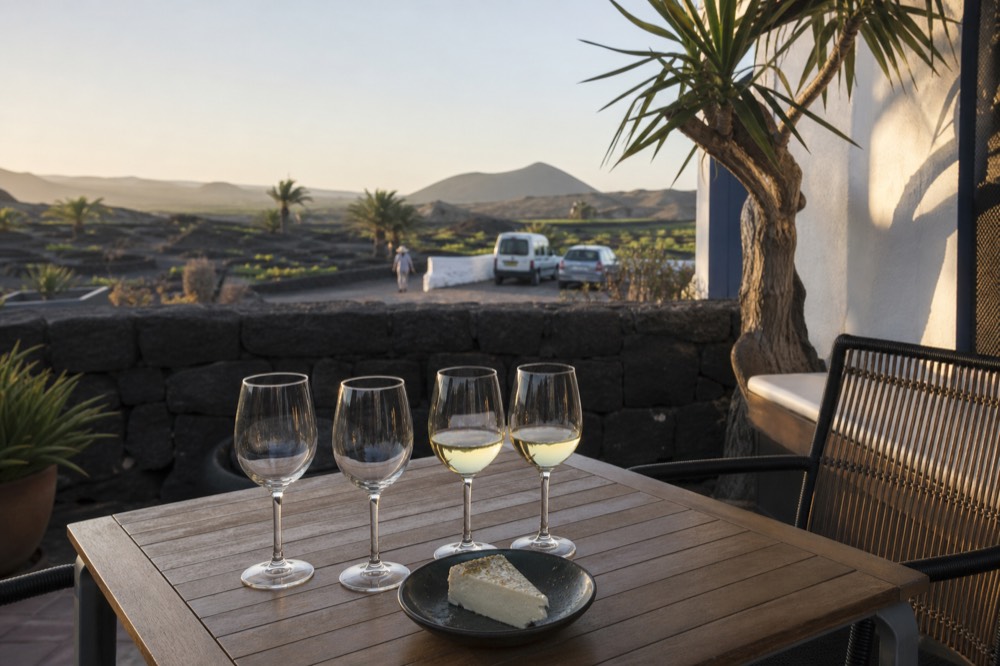
The clearest way to decide is to rank your reasons for the trip. If you want to stand in a vineyard that looks like the surface of another planet, taste volcanic Malvasía poured a few metres from where it grew, and be back at your hotel for a swim before dinner, Lanzarote does that with almost no friction. A single well-chosen tasting or a small-group hike through the volcanoes and vineyards, from $55 with wine and cheese included, rated 4.9 across 211 reviews, covers the essentials in four hours.
If your holiday is a week or more, and you want forests, a mountain, whale watching and several different wine areas in one trip, Tenerife is the richer itinerary and the awards say its wines are the ones to chase. The trade is complexity: more driving, more planning, more crowds at the headline sights. Plenty of travellers do both islands in one trip, flying between them in under an hour, and if wine is the spine of the holiday the sensible shape is Tenerife first, Lanzarote to finish, ending on the island where the wine country is the sight.
For a deeper read on the Lanzarote side of the argument, the La Geria wine region guide breaks down the landscape and the bodegas, and is Lanzarote wine any good answers the quality question with the 2026 medal record. This is the territory Lanzarote Wine Tours exists to cover, so the bias is declared: the landscape won us over. The numbers above are the numbers either way.
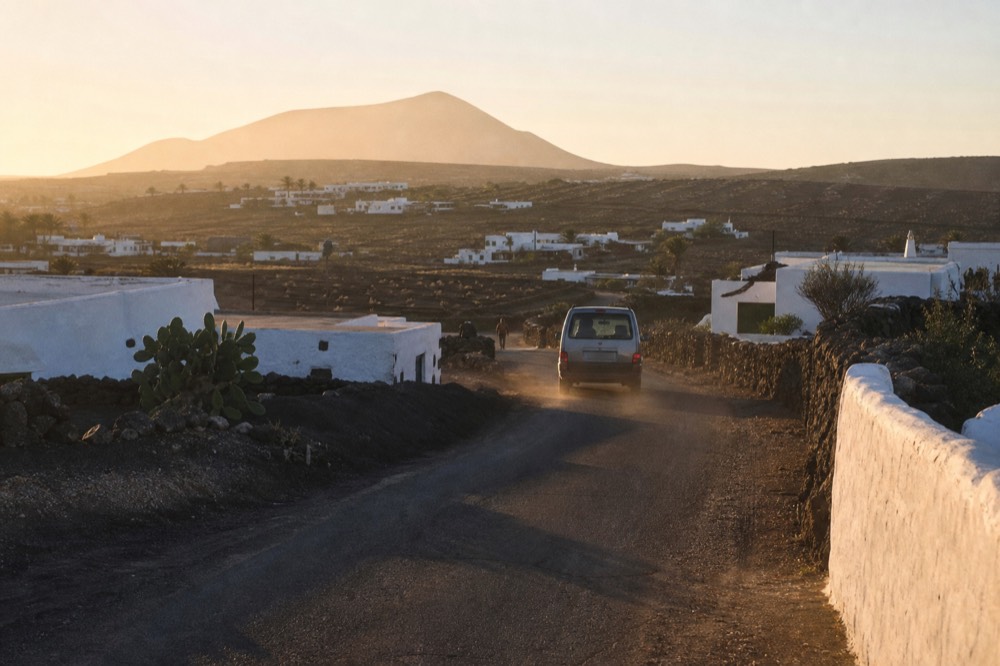
The short answers: Lanzarote for a wine-first trip, Tenerife for a longer and more varied holiday, Fuerteventura only if beaches outrank vineyards. Lanzarote is quieter and easier to get around, Tenerife has the broader wine scene and both 2026 top island wines. The questions below cover the specifics people ask most often.
Common Questions About Lanzarote Or Tenerife
Which Is Nicer, Lanzarote Or Tenerife?
Neither is objectively nicer. Tenerife offers more variety, more appellations and Spain's most visited national park; Lanzarote offers a volcanic wine landscape found nowhere else and much shorter driving distances. If wine country is the point of the trip, Lanzarote is the stronger pick.
Is Tenerife Or Lanzarote Better For Wine?
Tenerife has the broader wine scene: several separate appellations, higher vineyards and both top prizes at the Canary Islands' official 2026 competition. Lanzarote has one island-wide DO, roughly 84 per cent white wine, and a hand-dug ash-pit growing system recognised by the FAO since 2025.
Which Is Nicer, Lanzarote Or Fuerteventura?
For a wine-focused trip, Lanzarote. Fuerteventura is a beach island with no comparable wine industry. It suits travellers who rank coast and water sports above vineyards, and it is an easy ferry day trip from Playa Blanca.
Is Lanzarote Quieter Than Tenerife?
Yes. Lanzarote recorded 3,455,200 tourist arrivals in 2025 against roughly 7.4 million in Tenerife, and its airport handled 8,920,901 passengers against roughly 21 million across Tenerife's two airports.
Can You Do Both Islands In One Trip?
Yes, and it works well. Inter-island flights take under an hour, and the sensible wine-first shape is Tenerife for variety, then Lanzarote to finish in the vine-pit landscape of La Geria.
Do You Need A Car For The Wine Country On Either Island?
On Lanzarote, not necessarily: every resort is within half an hour of La Geria and several tours include pickup. Remember that Spain's breath-alcohol limit is 0.25 mg/l, lower than the UK's, so a tour with transport is the safer way to taste.