What Is The Best Wine From The Canary Islands?
A look at the best wines from the Canary Islands, how Lanzarote's Malvasía Volcánica compares to Tenerife's top reds, and the latest award-winning bottles.
What Is The Best Wine From The Canary Islands?
There is no single answer, because the Canary Islands are a patchwork of microclimates and ancient grape varieties. In 2026, the Canary Islands' own competition named two Tenerife wines as the best of the archipelago, but Lanzarote's Vega de Yuco Princesa Gara 2022 won Silver at the Decanter World Wine Awards, with 90 to 94 points. The real answer depends on whether you value volcanic minerality, a historic sweet wine, or a structured red.
The Canary Islands are not a single wine region. Seven islands, five with working vineyards, and several islands carrying their own Denomination of Origin labels that cover everything from misty cloud-forest slopes to the black-ash desert of La Geria. The best-known, and the one that consistently attracts the most international attention, is Lanzarote's Malvasía Volcánica, a grape that survives in pits dug into volcanic lapilli. But Tenerife, with its five DOs, produces equally compelling reds from Listán Negro and whites from Listán Blanco, and the sweet wines of Malvasía Aromática from the Valle de Güímar have a three-century reputation.
The honest starting point is that the Canary Islands' own official wine competition, the Concurso Oficial de Vinos Agrocanarias 2026, awarded its top prize ex aequo to two wines from Tenerife: Pico Cho Marcial Tinto from DOP Islas Canarias and Flor de Chasna Blanco Naturalmente Dulce from DOP Abona. Two Tenerife wines shared the top prize at the 2026 AgroCanarias awards, with Lanzarote also among the winners. That is partly a scale difference. Lanzarote's entire DO produced only 843,000 kilograms of grapes in 2025, a tiny fraction of the Canary Islands' total DOP grape production of 4.84 million kilos, and almost all of it is drunk within Spain. So when the question is "best," the fair answer is that Tenerife dominates the local competition, while Lanzarote's wines are the ones that break out in international contests like Decanter, Bacchus, and CINVE.
Which Canary Islands Produce Wine?
Lanzarote, Tenerife, Gran Canaria, La Palma, and El Hierro all have commercial vineyards, but the appellation structure is uneven. Lanzarote has its own DO, recognised in 1993, while Tenerife has five separate DOs: Tacoronte-Acentejo, Valle de Güímar, Valle de la Orotava, Abona, and Ycoden-Daute-Isora. Gran Canaria and La Palma each hold their own DO appellation, while the multi-island DOP Islas Canarias sits alongside them and can cover wine from any island.
Most of the islands' wine is white, and the overwhelming majority of it never leaves the Canary Islands. The 2025 DOP grape harvest across the archipelago fell 27% compared to 2024, to 4.84 million kilograms, blamed on drought and adverse weather. Lanzarote's harvest was especially small, at 843,000 kg, but the official qualification panel still rated the 2025 vintage "muy buena" after a blind tasting of 23 wines. This is a recurring theme: the Canary Islands produce some of the smallest, most volatile crops in Europe, but the quality holds up remarkably well.
| Island | Main DO(s) | Signature grapes | Notable recent recognition |
|---|---|---|---|
| Lanzarote | DO Lanzarote | Malvasía Volcánica, Listán Negro, Diego | Decanter Silver 2026 for Princesa Gara 2022; Bacchus Grand Gold 2026 for Timanfaya Malvasía Dulce Natural 2018; two gold medals at Mundus Vini 2026 for El Grifo |
| Tenerife | Tacoronte-Acentejo, Valle de Güímar, Valle de la Orotava, Abona, Ycoden-Daute-Isora | Listán Negro, Listán Blanco, Malvasía Aromática, Negramoll | Best Wine of Canarias 2026, awarded ex aequo to two Tenerife wines |
| Gran Canaria | DOP Islas Canarias | Listán Blanco, Vijariego | Occasional mentions in the Canary Islands competition; no major international awards in 2025-2026 |
| La Palma | DOP Islas Canarias | Albillo Criollo, Negramoll | Some wines bottled under the multi-island DOP; no recent standout results |
| El Hierro | DOP Islas Canarias | Vijariego, Listán Blanco | Small production, rarely seen outside the island |
The Tenerife DOs are the most prolific, and the island's high-altitude vines in the Orotava Valley, where braided cordons stretch for metres, produce some of the most distinctive whites in Spain. But Lanzarote's wines are the only ones grown in volcanic ash pits, and that unique terroir gives them a mineral, saline edge that is increasingly noticed by international critics. The Lanzarote Wine Tours site focuses on this island for a reason: the wineries are clustered along a single half-hour road, and the tasting experience is unlike anywhere else.
El Grifo, the winery whose history dates to 1775, makes a Malvasía Colección that is widely available in the UK and shows what Lanzarote's volcanic soils do to the Malvasía grape. It is a good entry point, but the real standout is the single-vineyard Princesa Gara 2022 from Bodegas Vega de Yuco, a Malvasía Volcánica aged on lees that won Silver at the 2026 Decanter World Wine Awards. The judges praised its typicity, acidity and mineral character. That is a better answer to the "best" question than any list of local prizes, because it is a blind assessment by a panel of Masters of Wine and Master Sommeliers.
If you prefer a sweet wine, the Timanfaya Malvasía Dulce Natural 2018 from Bodegas Timanfaya won a Grand Gold at Bacchus 2026, the highest award in that competition. It is made from desiccated Malvasía grapes, and it is one of the few Lanzarote wines that regularly appears on international retail shelves. On Tenerife, the Pico Cho Marcial Tinto and the Flor de Chasna Blanco Naturalmente Dulce are the wines to seek out, but they are much harder to find outside the islands.
Where Does Lanzarote Wine Rank Among The Canary Islands?
Lanzarote's DO is small, producing less than a sixth of the archipelago's total DOP grapes in 2025, but it punches above its weight in international awards. At the 2026 Agrocanarias competition, 251 wines from 65 bodegas were entered, and the top prize went to two Tenerife wines. Outside the Canaries, however, Lanzarote's medals at Decanter, Bacchus, and CINVE suggest that the island's wines are the ones making the deepest impression on non-local palates.
The difference is partly stylistic. Tenerife's wines are often more conventional in structure: Listán Negro reds with bright acidity, Listán Blanco whites with a smoky, sometimes reductive note. Lanzarote's Malvasía Volcánica, grown in deep ash pits with no irrigation, yields a wine that is lighter in body, higher in acidity, and marked by a distinct saline, almost iodine-like finish. That is a love-it-or-hate-it profile, but for the international critics who rate it, it is exactly what makes the wine stand out from the global crowd.
The 2026 harvest is projected to be much larger, over three million kilos, which might make Lanzarote wines slightly more available. But the fundamental constraint remains: the DO covers 1,894 hectares of registered vineyard, roughly the same area as a single large Bordeaux estate, and most of the wine is drunk in the Canary Islands. If you want to taste the best, you have to come here, or buy from a specialist importer like Vinissimus or Wine Shop Lanzarote, which ship to the UK.
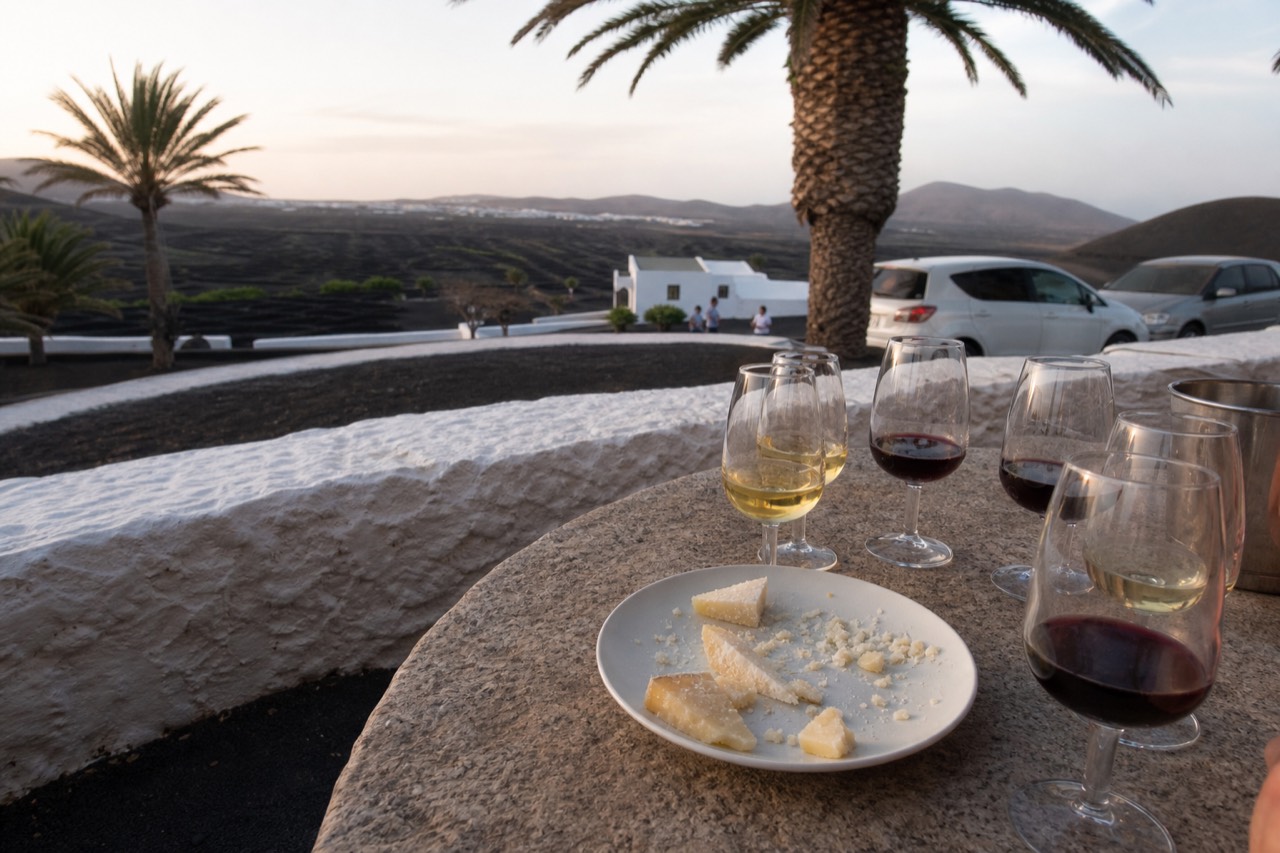
The volcanic-wine-tasting pairing at a small bodega in La Geria, with artisanal cheese and a seasonal Canarian plate, is a good way to experience the range in one sitting. The tour is capped at ten people, and you taste wines that are rarely exported, including a natural wine that spends months on skins. It is a direct way to understand why Lanzarote's wines are so different from anything made on the mainland.
What Makes Malvasía Volcánica The Signature Canary Wine?
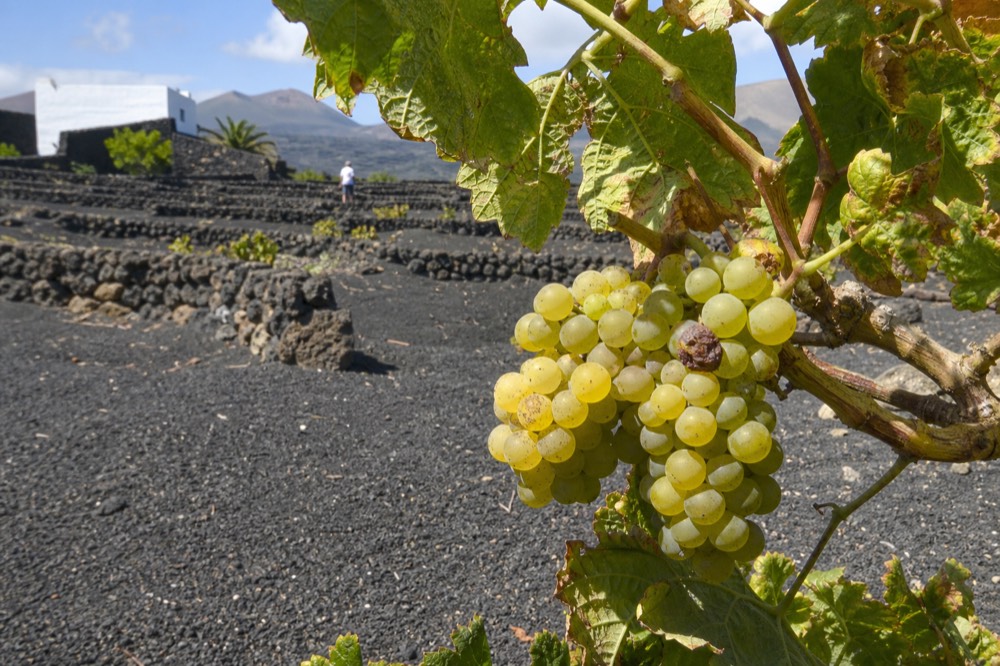
Malvasía Volcánica is the grape most closely associated with Lanzarote, and it is the first variety into the winery every harvest. Grown in pits dug through volcanic ash, it produces a wine that is lighter and more saline than almost any other Spanish white. The yields are tiny, around 1,000 kilograms per hectare against a legal ceiling of 7,000, and the resulting concentration gives the wine an intensity that belies its pale colour.
The grape is not exclusive to Lanzarote, but it is here that it reaches its most extreme expression. The ash layer, called picón or rofe, acts as a mulch: it lets rain soak straight through, stops the buried soil from drying out, and evens out soil temperature. The vine roots deep, down to the pre-eruption soil two metres below the surface, and the result is a wine with a mineral backbone that is hard to replicate elsewhere. The DO's own specification describes the growing conditions as hyperarid, with under 150 millimetres of rain a year and effectively none between June and August.
The 2025 harvest was a difficult one: only 843,000 kilos of grapes across the entire island, yielding 1,502,656 bottles. Yet the Consejo Regulador rated the vintage "muy buena" after a blind tasting of 23 wines. In 2026, the harvest is running far ahead, with growers paid about four euros a kilo, and the Consejo Regulador expects the final volume to exceed three million kilos. That still makes it a tiny appellation by any standard, but it means more bottles of Malvasía Volcánica will reach the market in 2027.
The grape's reputation is growing. The Decanter Silver for Princesa Gara and the eleven medals Lanzarote bodegas took at CINVE 2026, four of them Grand Golds, all point to a wine that is being taken seriously by international judges. The El Grifo Orange Wine, a 2025 release of Moscatel de Alejandría from century-old vines, is made with extended skin contact and clay-tinaja ageing, with no added sulphites. It is a small run, and a sign that Lanzarote's winemakers are experimenting with styles that appeal to natural-wine drinkers as well as traditionalists.
The El Grifo bodega tasting is a direct way to try Malvasía Volcánica in the place where it is grown. The 50-euro Wine Lovers tour includes a guided walk through the 18th-century winery, a tasting of six wines with Canarian cheeses, and a visit to the wine museum that holds bottles dating back to 1881. It is limited to 12 people and runs in English and Spanish.
For a broader view of how Lanzarote's wines compare to the rest of the Canary Islands, the Lanzarote wine brands worth buying guide covers the bottles that are actually available in the UK and the tasting notes that come with them. And if you are wondering whether the wines are genuinely good or just unusual, the piece on whether Lanzarote wine is any good breaks down the 2026 awards in detail.
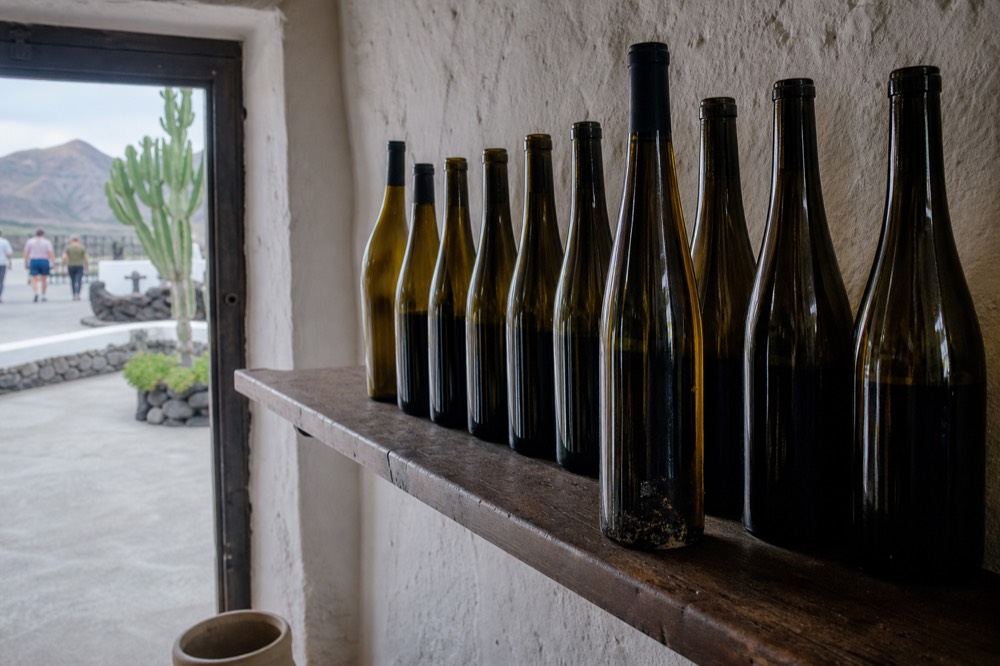
The Canary Islands are not a single wine region, and the "best" wine depends on the competition you are looking at. The local Agrocanarias judges consistently favour Tenerife's reds and sweet wines. The international panels at Decanter, Bacchus, and CINVE consistently reward Lanzarote's Malvasía Volcánica. The honest takeaway is that both islands make exceptional wines from grapes that exist nowhere else in the world, and the best way to decide is to taste them side by side, preferably in the volcanic pits where they are grown.
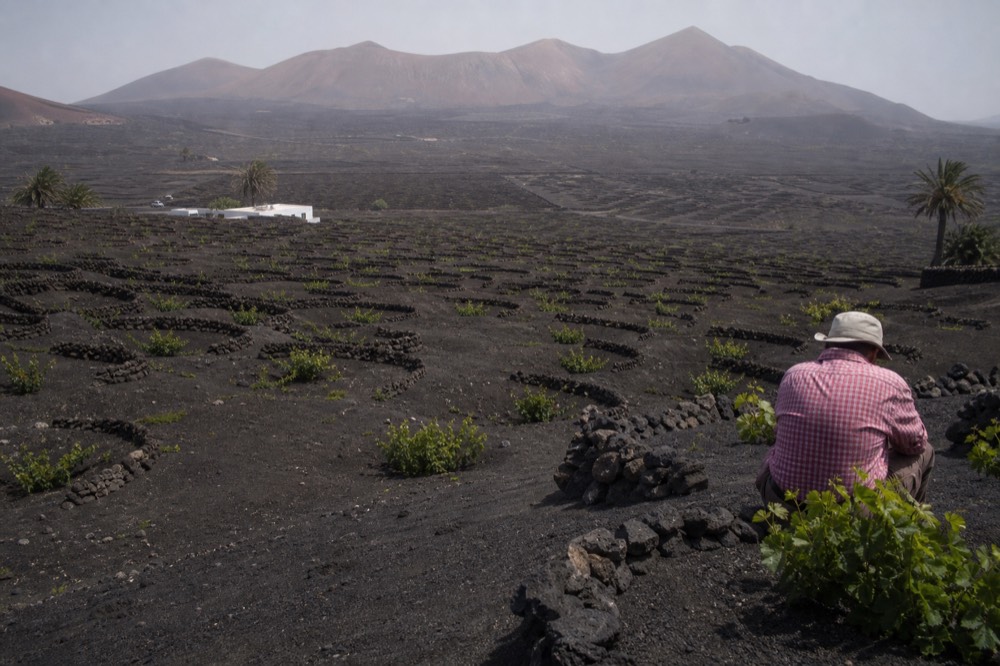
Malvasía Volcánica vines are planted at the bottom of funnel-shaped pits, each sheltered by a low semicircular stone wall known
Malvasía Volcánica is not the only grape on the island, but it dominates the vineyard. The DO allows a handful of other white varieties, including Diego, Listán Blanco, Moscatel de Alejandría, and Burra Blanca, and there are small plantings of red varieties such as Listán Negro and Syrah. Malvasía Volcánica nonetheless sets the tone for the whole appellation: it is the island's signature grape and the first variety into the winery every harvest. Most of it is made as a dry white, though a smaller share goes into sweet wines, and the grape handles both styles well because of its natural acidity.
The grape's origins are a subject of some debate. What is not disputed is that it is distinct from the Malvasía grown on the Spanish mainland, and that Lanzarote's version has adapted over generations to the island's ash-covered terrain. The vines are trained low in the pits, individually rather than in rows or on trellises, because there is no rain to grow towards and the wind would shred anything taller. Every pit is dug by hand, and because the ash is loose and the walls are dry stone, the vineyards look less like farmland than like a landscape of small craters.
That landscape is also why visiting is worthwhile. La Geria, the main growing zone, sits between the Timanfaya lava fields and the village of Masdache, and the road through it passes bodega after bodega, several of which welcome walk-ins for tastings. The combination of black ash, green vines, and white stone walls is unlike any other wine region in Spain, and it is the visual signature of Malvasía Volcánica before you have tasted a drop.
In the glass, the dry style typically shows citrus and stone fruit with a saline finish, and it pairs naturally with the island's seafood, fresh goat cheeses, and the salt-crusted potatoes known as papas arrugadas with mojo. Because the wines are high in acidity and relatively low in alcohol, they are best drunk young and well chilled, ideally within a few years of the vintage. Sweet versions, made traditionally by stopping fermentation early or from late-picked grapes, offer honeyed and dried-fruit notes while keeping that same mineral edge.
One practical note for visitors: the same wind that keeps the vines low can make La Geria surprisingly cool, even in summer, so bring a layer if you are booking a tasting or vineyard walk. Most bodegas are a short drive from the main resorts, and many of the smaller family operations sell bottles you will not find outside the island, which makes a boot full of Malvasía Volcánica one of the more reliable souvenirs of a trip to Lanzarote.
A few numbers help put the appellation in perspective. The gap between the legal ceiling of 7,000 kilograms per hectare and Lanzarote's actual 1,000 means the island's growers work seven times harder, in effect, for every bottle than the rules would allow elsewhere in Spain. The 2025 figure of 1,502,656 bottles sounds like a lot until you spread it across every shop and restaurant that wants them, which is why vintages sell through quickly and why the larger 2026 harvest, expected to top three million kilos, matters to anyone hoping to buy rather than merely read about these wines.
The economics also explain part of the character. At about four euros a kilo in 2026, grape prices reward the hand labour that every pit demands, since no machine can work a vineyard where each vine sits alone at the bottom of its own hollow. That cost is passed into the bottle, and it is the reason a dry Malvasía Volcánica sits at a slightly higher price point than mainland Spanish whites of comparable weight, a premium that the saline, mineral profile goes some way to justifying.
Common Questions About The Best Canary Islands Wine
What Is The Best Wine From The Canary Islands?
The best wine depends on your taste, but the most internationally recognised in 2026 is the Vega de Yuco Princesa Gara 2022, a Malvasía Volcánica from Lanzarote that won Silver at the Decanter World Wine Awards. On Tenerife, the Pico Cho Marcial Tinto and Flor de Chasna Blanco Naturalmente Dulce shared the top prize at the Canary Islands' own 2026 competition.
Do The Canary Islands Have Good Wine?
Yes, the Canary Islands produce some of the most distinctive wines in Spain, thanks to ancient vines, volcanic soils, and a climate that is closer to a desert than to mainland Europe. The wines are increasingly winning medals at major international competitions.
Which Canary Island Makes The Best Red Wine?
Tenerife is generally considered the leader in red wines, particularly Listán Negro from the Valle de la Orotava and Tacoronte-Acentejo. Lanzarote's reds are less common, but a few producers, like Vega de Yuco with its Esencia Yaiza, have won awards for Listán Negro at the International Volcanic Wine Awards.
Where Can I Buy Lanzarote Wine Outside Spain?
Specialist importers like Vinissimus and Wine Shop Lanzarote ship to the UK and Ireland, though availability is limited because most of the island's production is consumed locally. The Bodegas El Grifo Malvasía Colección is one of the easier bottles to find online.
Is Lanzarote Wine Better Than Tenerife Wine?
It is not a question of better or worse, but of style. Lanzarote's wines are lighter, more saline, and more mineral-driven, while Tenerife's are often more structured and aromatic. In international blind tastings, Lanzarote's Malvasía Volcánica has recently won higher scores, but Tenerife's wines dominate the local competition.